
The Regency Wardrobe collection - research & making - Wildflowers
Updated: Aug 28, 2025

African Daisy - "The scientific name..." Osteospermum "...is derived from the Greek osteon (bone) and Latin spermum (seed). It has been given several common names: African daisy, South African daisy, Cape daisy and blue-eyed daisy..."
Overview:
Wildflowers
Collection: The Regency Wardrobe
Garment: Woman’s paper fan Materials: paper, cartridge paper, quilling paper strips, card, Japanese rice paper Mizuhiki cord, tissue paper, embroidery thread, lacquer, pencil
This piece was created in parallel with the production of a series of wildflower photographs commissioned from photographer Ray Sullivan. On the front of the fan are small drawings of thirteen of the flowers from his final series.
These are: Osteospermum - African Daisy; Taraxacum officinale - Dandelion; Rosa canina - Dog Rose; Calystegia sepium - Wild Morning Glory; California Poppy - Eschscholzia californica; Potentilla reptans - Creeping cinquefoil; Papaver rhoeas - Poppy; Centaurea cyanus - Cornflower; Bellis perennis - Daisy; Calendula officinalis - Marigold; Malva sylvestris - Common Mallow; Taraxacum - Dandelion clock; Coreopsis - Tickseed.
Whilst the names of two of the parts of any fan link to botany, its leaf and sticks, this piece is inspired more specifically by the colourful semi-translucency of tiny, often overlooked, common wildflowers. The fan is made from sheer paper as a means of suggesting a gentle breeze across a wildflower field. Wildflowers was inspired also by the Botanical Fan, a printed fan from 1792, held at The Fan Museum, Greenwich. Printing had begun to make the mass production of fans possible even before the Regency; spreading particular fan designs around like wildflowers. Another Botanical Fan can be found in the V&A collection. It was printed by Sarah Ashton, one of many prominent female publishers of fan leaves in the late 18th century and a member of The Worshipful Company of Fan Makers from 1770. Many Regency era printed fans were decorated with text, partly or wholly, thereby informing and educating the ladies who used them. On the back of Wildflowers is a little about the taxonomy of each flower portrayed on its front, written faintly in pencil as if written during a lesson.
Research
First we photographed wildflowers
Throughout the period of making The Regency Wardrobe collection I have also been working with the impressively talented photographer Ray Sullivan. That is, both in documenting the pieces I've made and by my requesting images of specific subjects to support the pieces, such as when I've asked for a background image for a certain shoe. In the case of Wildflowers I planned to draw wildflowers on the surface of the fan and needed images to work from; that was all I asked for but what he created was a beautiful photographic series, important in its own right.
There are more images in the entire series than are shown here. For the entire series please see: (to follow). The 12 shown in this post are those that I chose to incorporate into The Wildflower Fan. There is more about the rest of the background research behind the fan below, including why I chose to look into the etymology of the names of each flower.

Dandelion - "...a contraction of dent-de-lioun, from Old French dent de lion, literally "lion's tooth" (from its toothed leaves), a translation of Medieval Latin dens leonis. From Latin dens (genitive dentis) "tooth," from PIE root *dent- "tooth" + leonis, genitive of leo "lion"..." Scientific name Taraxacum.

Dog Rose - "The botanical name is derived from the common names 'dog rose' or similar in several European languages, including classical Latin and ancient (Hellenistic period) Greek. It is sometimes considered that the word 'dog' has a disparaging meaning in this context, indicating 'worthless' as compared with cultivated garden roses. According to The Oxford Dictionary of Phrase and Fable, the English name is a direct translation of the plant's name from classical Latin, rosa canina, itself a translation of the Greek κυνόροδον ('kunórodon'); the name arose out of the belief in classical times that the root was a cure for the bite of a mad dog. It is known to have been used to treat the bite of rabid dogs in the 18th and 19th centuries. The origin of its name may be related to the hooked prickles on the plant that have resemblance to a dogs canines. The Roman naturalist Pliny attributed the name dog rose to a belief that the plant's root could cure the bite of a mad dog. It is not clear if the dogs were rabid. Other old folk names include dogberry and witches' briar..."

Wild Morning Glory - "...scientific name is Calystegia sepium. This comes from the Greek kalu “cup” and stegos “a covering” for the genus name Calystegia and sepium means “of hedges” or “of fences”, because of its climbing tendencies. In addition to wild morning glory, the plant has...common names including old man’s cap, devil’s guts, bride’s gown, white witches’ hat, Rutland beauty, great bindweed and hedge bindweed. It is a member of the Convolvulaceae, the morning glory family..."

California Poppy - Scientifc name Eschscholzia californica."The early Spanish settlers of California saw vast displays of the California Poppy lighting up the coastal hillsides, and it is said they could guide their ships by the sight. They called the California coast the “land of fire,” and the plant the “cup of gold,” (“copa de oro”). It is also known as the Golden Poppy and Cups of Flame. The botanical name Eschscholzia (despite the misspelling) honors German surgeon and naturalist Friedrich Gustav von Eschscholtz, who saw the San Francisco Bay area hills emblazoned with California Poppy while on a Russian expedition ship in the early 19th century..."

Creeping cinquefoil - scientific name Potentilla reptans - " Potentilla, the genus name, means 'powerful, despite its small size' and is a reference to the claimed medicinal value of plants in this genus. The specific epithet reptans means creeping or crawling [like a] reptile."

Poppy - "...late Old English popig, popæg, from West Germanic *papua-, probably from Vulgar Latin *papavum, from Latin papaver "poppy," perhaps a reduplicated form of imitative root *pap- "to swell." Associated with battlefields and war dead at least since Waterloo (1815)..."

Cornflower - "Centaurea cyanus, commonly known as cornflower or bachelor's button..."
"...any flower or plant growing in grain fields"...1570s, from corn (n.1) + flower (n.)..."

Daisy - "...daiseie, from Old English dægesege, from dæges eage "day's eye;" see day (n.) + eye (n.). So called because the petals open at dawn and close at dusk. In Medieval Latin it was solis oculus "sun's eye." The use of dais eye for "the sun" is attested from early 15c..."

Calendula: "The genus name Calendula is a modern Latin diminutive of calendae, meaning "little calendar", "little clock" or possibly "little weather-glass". The common name "marigold" refers to the Virgin Mary..."

Comon Mallow - Scientifc name Malva sylvestris. Sometimes called buttonweed, cheeseplant, cheese cake, cheeseweed, dwarf mallow and roundleaf mallow. "...Our English word "mallow" and the genus name Malva have a common root in the Greek malache or malakos, meaning "soft". Etymologists do not know whether this refers to the plant's downy leaves, to the "soothing, gelatinous properties of the roots" uses medicinally, to the emollient which can be made from the seeds or leaves, or to the relaxing powers of tea made from the plant. Around 1000 A.D., the name of this plant was written as malwe, malua, mealwan, and mealuwe...The French call it "mauve," from the same root as mallow; in English this word has come to designate a color...Malache also has given us "malachite' (copper ore)-a stone "the same shade of green as mallow leaves"..."

Dandelion clock - "...folk names, like tell-time refer to the custom of telling the time by blowing the white seed (the number of puffs required to blow them all off supposedly being the number of the hour), or to the plant's regular opening and closing with daylight. Other names refer to its diuretic qualities (Middle English piss-a-bed, French pissenlit)..."

Coreopsis - "...a genus of flowering plants in the family Asteraceae. Common names include calliopsis and tickseed, a name shared with various other plants....The flowers are usually yellow with a toothed tip. They are also yellow-and red bicolor...The flat fruits are small and dry and look like bugs...The name Coreopsis is derived from the Greek words κόρις (koris), meaning "bedbug", and ὄψις (opsis), meaning "view", referring to the shape of the achene..."
One of the first research visits I made for this project, in order to see garments and accessories from the Regency era, was to The Fan Museum, Greenwich. They had on an exhibition entitled Early Printed Fans. I quickly understood that the range of subject matter printed on late eighteenth and early nineteenth century fans was expansive but there was one fan in particular that has stayed at the forefront of my memories from that visit.
Called Botanical Fan in the exhibition, it seems to sum up many of the changes afoot in society, in particular regarding female society at that time (for fans were mainly used by women). The fan is dated 1792 and the fact that I've since found another fan exactly the same in the V&A collection neatly demonstrates how printing had begun to make the mass production of fans possible by that date; this made them more affordable which in turn of course made them more accessible to women of all classes.
Many printed fans from that period include text (some are covered only in writing) which shows that many women were able to read. But looking at the particular subject matter printed on fans of this period also tells us what women were keen to read and learn about, as they sat together, keeping cool, reading from their fans.

I have said elsewhere that I love the fact that the paper part of a fan is called it's leaf. I also smiled at the slightly risque fact that the imagery and text on this particular fan is not only a general lesson in botany but, in particular concerns the reproductive aspects of that subject - "...the front leaf is etched with botanical drawings of the sexual anatomy of plants arranged according to Carl Linnaeus's (1707-77) classification" http://m.vam.ac.uk/collections/item/O366497/fan-ashton-sarah/ - for it seemed to me to contradict (or happily expand) the impression I had of what might have been considered proper subject matter for a young lady of this time to read about.
I also love that the leaf of this fan was published by a woman: "It is worth mentioning...that many printers in England were women: Honour Chassereau, Martha Gamble, Marth and Esther Sleepe, Sarah Ashton, to name by a few..." from The Fan Museum - Early Printed Fans (exhibition guide).

Detail of the front of the Botanical fan, or Botanick Fan as it was originally called
"Sarah Ashton advertised 'The Botanick (sic) Fan' on 1 August 1792 in 'The Public Advertiser'..." Each drawing on the front is "...numbered with a Roman numeral and briefly described...On the back of the mount there are two lists of the drawings on the front with botanical descriptions...An image of a flower and a description of a flower's principal parts are printed between the lists, followed by some lines of verse from 'The Botanick Garden', a poem written by Erasmus Darwin (1731-1802)..." The stanza quoted begins "...'Come ye soft Sylphs, who fan the Paphian Groves...Erasmus Darwin's stated aim in writing 'The Botanick Garden' was to 'inlist the Imagination under the banner of Science', 'to induce the ingenious to cultivate the knowledge of Botany', and to introduce them to the 'immortal works of the celebrated Swedish naturalist Linnaeus'...The fan would have appealed to the many female readers of 'The Botanic Garden'. Darwin supported female education. In 'A Plan for the Conduct of Female Education in Boarding Schools' (1794), written as advice to his two daughters, the Misses Parker, who had opened a school in Ashbourne in 1794, he recommended that the girls should learn botany, chemistry, mineralogy, and short hand, and should take plenty of outdoor exercise...Sarah Ashton was a prominent publisher of fan leaves in the late 18th century from her business in Little Britain, near St. Martin's Court, Covent Garden. She was admitted in 1770 into The Worshipful Company of Fan Makers and carried on the printing business after her husband’s death." - https://collections.vam.ac.uk/item/O366497/fan-sarah-ashton/
For more about the fascination for botany during the Georgian, Regency and Victorian periods please see: https://www.tandfonline.com/doi/pdf/10.1080/23311983.2017.1364058
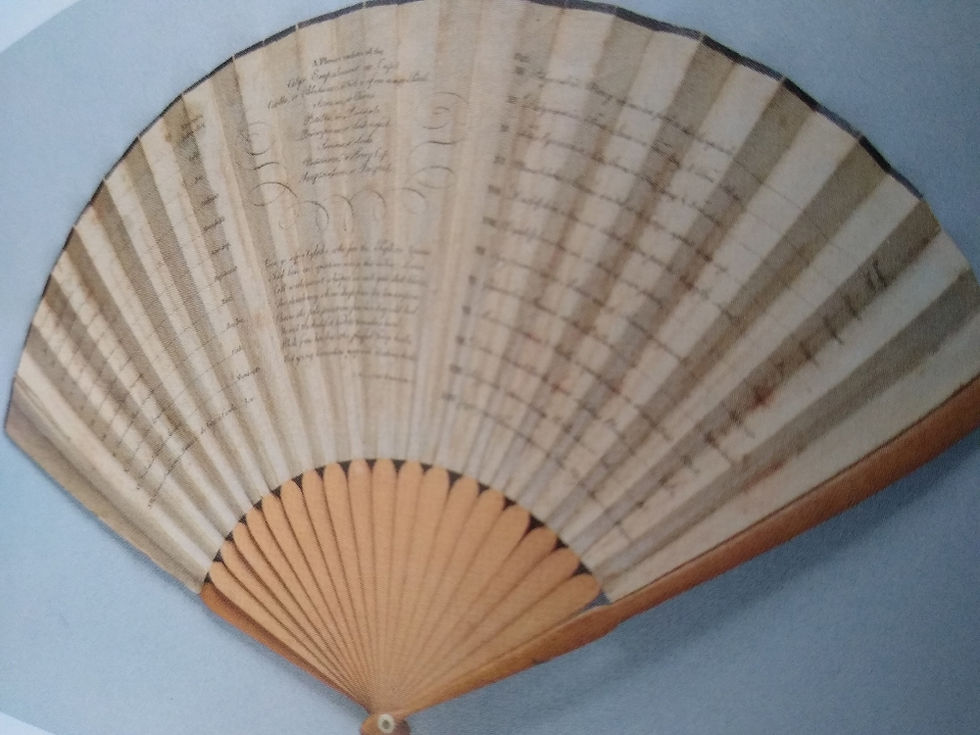
The back of the Botanick Fan
To read more about my visit to The Fan Museum please see: https://www.stephaniesmart.net/2018/06/13/the-fan-museum-research-visit-fans
So it was that in my mind my own wildflower fan was conceived. This is the preliminary sketch:

I realised quickly that I wanted to have images of particular British wildflowers to draw on the fan's leaf but when my simple request for images turned into a spectacular series of photographs I knew the photographs must be exhibited beside/behind the fan. I foresaw them printed individually but displayed en masse, as in nature, each tiny flower glorious, glowing and semi-translucent against its black background; the fan in front suggestive of a light breeze such as might blow across a field of wildflowers.
So I wanted the fan to have the look of semi-transparency. I wanted it to have a sheer, ephemeral quality, mimicking the petals of a flower and suggestive in it's material form of the softness of that breeze, even whilst it would be displayed stationary. In keeping with the muted, cream backed colour scheme of the Botanick fan I bought a large sheet of semi-translucent cream coloured paper with soft edges and planned to use tissue paper to colour the individual images of the flowers. Though I thought about making the 12 wildflowers I would be portraying 3-dimensional in some way, my original inspiration, the Botanick fan, had been all about the flat graphic and the use of text. Instead therefore I sketched them lightly and applied the colour from behind. This softened the effect of it, as it would only become apparent when the fan was held to the light.
This layering of sheer papers eventually informed how I would make the one three-dimensional flower I knew there must be. The one that would sit at the centre point from which the fan fanned out. Whilst other parts of the fan have specific names this part is normally just called a rivet, as far as I can tell. For me, the idea of making a rivet that was merely functional and meant to be visually ignored seemed like a wasted opportunity. So, inverting the idea of it's usual relative invisibility, I decided, on this fan, the hinge that would make the fan able to spread out and show itself would itself be made a central focus.

My first attempts however, at capturing the delicacy of a wildflower in three-dimensions, proved utterly unsuccessful. It was only be returning to the idea of applying sheer colour to the underside of sheer cream paper (in this case tissue paper) and combining that with, not too many, opaque lines and minimal/pale pencil lines that I could stop abandoning failed paper flowers and insert a successful one through the bottom end of the sticks and guards.
Whilst deciding what to write on the back, in imitation again of the Botanick fan, I was simultaneously researching the flowers in the photos Ray had taken. Neither of us are botanists so some were unknown to us both.
This process of identification always began of course with classification, that is, by naming the flower itself. Whilst doing that one is introduced to the idea of genus and species and common names and Latin names, modern, scientific and folk names. Etymology is an interest of mine. How the parts of words have other meanings and combine to describe this thing or that I find fascinating. As in this case names were necessarily the start of my learning about my subject matter so it was the etymology of the plants names, scientific, Latin and folk that I pencilled lightly on to the reverse leaf of this fan.
I decided to leave empty the area below each flower on the front leaf. That this fan has sticks which, when light is shone from behind, look like the stems of the flowers, plus a front and a back leaf, seemed like enough extra plant related detailing.
The fans are the only items in The Regency Wardrobe collection of garments that are actually meant to be made of paper and I suppose I was thinking also as such it would be nice to leave the papery front surface of this one with blank space on it, as if to be written on. That the young lady who might feel its gentle breeze on her face and read and learn from its back surface would also have room, should she wish, to write her own thoughts, for others to see, on its front.

A close up of Wildflowers
This project has been supported by:


