
Weaving Silk Stories - research & making - Decorated Men
Fashion research
“At the beginning of the 18th century the male silhouette differed greatly from that of today. A typical outfit consisted of a full-skirted knee-length coat, knee breeches, a vest or long waistcoat (which could be sleeved), a linen shirt with frills and linen underdrawers. Lower legs showed and were an important part of the silhouette. Men wore silk stockings and leather shoes with stacked heels of low or medium height. The whole ensemble would have been topped by a shoulder-length full-bottomed wig and a tricorne (three-cornered) hat with an upturned brim. As the century progressed, the male silhouette slowly changed...Undergarments and knee breeches did not change very much. Coat skirts gradually became less full and the front was cut in a curved line towards the back. Waistcoats became shorter. The upper leg began to show more and more and by the end of the century breeches fitted better because they were often made of knitted silk. Shoes became low-heeled with pointed toes and were fastened with a detachable buckle and straps or ribbon on the vamp (the upper front part of a boot or shoe)."
For a brief overview of these changes please see: https://www.historicalmenswear.com/1700s/
It is also interesting to read how the coat turned into the frock coat here: https://en.wikipedia.org/wiki/Frock_coat
You can see a pair of knitted silk breeches from the end of the 18th century here: https://collections.vam.ac.uk/item/O75637/breeches-unknown/
During the 1700s men dressed equally as elaborately as women (this was not a new phenomenon as this portrait of Dudley, the 3rd Baron North from 1615 shows). Their dress included the use of lace, bead work or jewels, silk woven fabrics and embroidery.
Colour
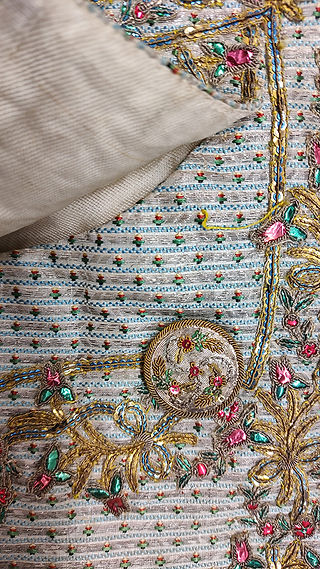
Ivory/cream - as part of my research for the Weaving Silk Stories collection I made a research visit to Hampton Court Palace to see items from the Royal Ceremonial Dress Collection. We will track all the male garments I include in this post through a rainbow of colours but two of the pieces I saw on that early visit were beautifully embroidered male coats on a background of cream or ivory. This was reminiscent of all the cream ground I had seen in silk made in Spitalfields for womenswear which you can read more about here



© Historic Royal Palaces
Ivory silk coat from Court Suit 1760 to 1790 (c. 1780) - 3501301 "Ivory silk brocaded with silver metallic thread and tiny ivory, pink, green and black 'rosebud' spots and alternating thin blue floss silk brocaded bands, these forming thin horizontal stripes. Embroidered at cuffs, front edges, collar, edges to collar, skirt edges at back, pocket flaps and buttons. Lined ivory twill, silk satin. Sleeves lined same, with approx. (2 1/2 [6.4cm]) of coarse cream linen at back sleeve at cuff. Slim cut, seamed centre back and from shoulders at back. Stand collar (3/4 [1.2cm]) wide centre back. Fronts cut away, tapering gently towards back, fastening metal hook and eye at collar and breast. Twelve linen backed, embroidered buttons at front edge for decorative purposes. Tight gauntlet cuffs (3 3/4 [9.5cm]) wide each decorated with three buttons. Cream silk net sleeve ruffles, embroidered cream foliage, edged with tatting. Pockets at hip, one either side opening at front. Pointed pocket flaps, button under each point, three either side."
- From the Royal Ceremonial Dress Collection catalogue text © Historic Royal Palaces
"...most men chose the decorative trimmings for their jackets and waistcoats from small embroidery samples assembled by the merchant, and often they deferred to the merchant's intimate knowledge of the latest fashions. Although the merchant did none of the practical work himself, he acted as a mediator between customer and maker—negotiating the costs of labour and materials, and arriving at a final price for an individual embroidered design. Generally such lavish items were purchased on credit, as most of the merchant's trade operated on a "take now, pay later" basis. Perhaps this explains why, as the author of The Art of the Embroiderer noted in 1770, customers were not deterred by embroidered fabrics for men's suits that cost much as six hundred francs per aune (approximately 1.2 meters, or 1.3 yards)"
I talk of the role of Mercers (merchants) more in this post here


© Historic Royal Palaces
"Coat c.1770 - 3500902 - Ivory silk satin, brocaded tiny dots in pinks and greens in between fine laid gold threads, these forming thin stripes. Embroidered at cuffs, front edges, edges to collar, skirt edges at back, pocket flaps and buttons. Lined ivory silk satin, the sleeves with coarse white linen. Chamois leather patches at armpits. Slim cut, seamed centre back and from shoulders at back. Stand collar (2 [5 cm] at centre back). Fronts cut away, tapering towards back, fastening metal hook and eye at collar and breast. Ten buttons, covered and embroidered, at front edge for decorative purposes. Tight gauntlet cuffs (4 3/8 [11.3 cm] wide), each decorated three buttons. Pockets at hips, one either side opening at front. Pointed pocket flaps, a button under each point, three either side. Lined on inside ivory silk satin. Pocket bag of coarse white linen. (In left hand pocket, a sleeve ruffle of ivory silk organza). Pleated skirts, either side vent at centre back. Two buttons at waist and two lower edge skirts, one either side. Handmade."
- The Royal Ceremonial Dress Collection catalogue text © Historic Royal Palaces
I have written in a separate post about thread buttons which appear on both male and female garments from this times. Above you can also see some extremely beautiful examples of fabric covered and embroidered buttons also worn by men.
"In the 1700s, in keeping with the extravagant Baroque court era, buttons, especially men's buttons, entered their golden age as a handcraft and many guilds of button craftsmen were established. In the Rococo age, buttons were seen as an elegant status symbols, and many sophisticated examples were made with intaglio or inlay pearl-shells, or decorated with painted ivory. These buttons included those made with micro mosaic techniques or with superb embroidery skills."
In the autumn of 2023 I visited Henfield museum for the first time to see five beautiful pieces from their collection. The piece I had most specifically asked to see was this waistcoat:

"Undoubtedly one of the finest items in the collection, this elaborately decorated silk waistcoat dates from the zenith of an extravagant era in male fashion. From the Wilberforce family, it may have once belonged to the famed abolitionist William Wilberforce."
The provenance details of this piece (BX89 B454) states:
"worn by Bishop Wilberforce."
There were two of them however. Samuel (1805-1873) Bishop of Oxford and Winchester and:
"...Samuel's son Ernest (1840-1908) who became Bishop of Newcastle upon Tyne and then Chichester. Samuel and Ernest were the son and grandson of politician and leading abolitionist William Wilberforce (1759-1833). The back has at some stage been opened at the centre seam and cotton bands added to increase the size. Waistcoat backs were often plain. 'Sew your own kits' were sold of the decorated pieces of the garment so you could have it made up for you. The buttons are beautifully decorated."
- Henfield Museum catalogue © Henfield Museum
"With embroidered floral patterns in coloured and silver thread and inlaid blue and white glass petals, the number of hours put into creating this stunning piece of clothing by extremely skilled craftspeople can only be imagined - along with the undoubtedly vast cost for such work."

You can get an idea of how such a waistcoat might have been created here: https://www.artic.edu/artworks/102999/embroidered-fabric-for-a-man-s-waistcoat-front


© Henfield Museum
Here is William Wilberforce himself (though dressed much more dourly)

William Wilberforce 1759 -1833, seemed interesting to me as part of my research for Weaving Silk Stories in part because from 1787 he:
"...was prominent in the struggle to abolish the slave trade and then to abolish slavery itself in British overseas possessions."
Wilberforce is not an uncontroversial character in this regard, because despite his concerns for slavery abroad some believed he did not extend the same sympathy for those working in harsh working conditions at home: https://crossworks.holycross.edu/cgi/viewcontent.cgi?article=1003&context=fenwick_scholar
In my research for Weaving Silk Stories I have needed to necessarily consider Britain's international trading of goods including textiles during the historical periods under consideration, in relation to the history of silk in the UK, so the international slave trade might have been a factor to consider. But because my primary focus is the history of silk that was made as well as worn in the UK I found myself drawn in the end to focusing on the hardships experienced by British weavers, in relation to the making of silk, instead. I will focus on this in an independent post.
Note: because I relate to stories and history through clothes I wanted
to include this link to an article that concerns a silk reticule made by a female
rights group in the 1820s to support the campaign to abolish slavery -https://saffronwaldenmuseum.swmuseumsoc.org.uk/black-history-month-slavery-abolition-reticule/
Did William Wilberforce not support better working conditions in the silk industry in Britain?
In fact it turns out that he was descended from silk manufacturers on his mothers side:
"William Wilberforce's mother was Elizabeth Bird (1730-1798) daughter of Thomas Bird. Her sister was Mary Bird (1724-1780) who was Abel Smith 's grandmother, having married Abel Smith (1717-1788). Abel Smith was thus a first cousin once removed of William Wilberforce. (Thomas Bird's son, John Bird of Coventry and London, married Judith Wilberforce, daughter of William Wilberforce (1690-1776). Their son William Wilberforce Bird (1758-1836) was an MP. The Bird family of Coventry were silk manufacturers.)"
I knew it was important to look up the political history of the silk industry in Britain as part of this project, because it had a big influence on the initial success but eventual decline of the industry. I go into this is a bit more detail in other posts so for now I will just include some of the interesting links I looked at (showing mention again of the Mercers):
- https://archives.parliament.uk/collections/getrecord/GB61_HL_PO_JO_10_3_212_48- https://www.british-history.ac.uk/vch/middx/vol2/pp132-137
I am wondering whether to write text from a silk related act of parliament on one of the two male coats that will be part of the the Weaving Silk Stories collection
Purple - in September 2023 I visited the Crown to Couture exhibition at Kensington Palace. Some of the pieces on show came from The Royal Ceremonial Dress Collection https://www.hrp.org.uk/kensington-palace/whats-on/crown-to-couture/
Standing next to a cotton dress this stunning velvet coat demonstrates how floral and feminine some of the male embroidery could be. As you will read below that is not only a modern point of view.
Note: It's important to remember that velvet would at this point in history have made called silk velvet, and made from silk
.


"Suit 1769-1771- This exquisite suit is Italian. Sir Watkin Williams-Wynn probably bought it on his travels to Italy which were considered an essential part of a gentleman's education. All things Italian became fashionable, especially clothes. The young men who wore them were "macaroni" after the pasta. they were often drawn looking feminine and camp. Its easy for modern viewers to mistake these images, or even the idea of being a macaroni as expressions of effeminacy or homosexuality. However macaroni dress was often intended to show off a sophisticated and intellectual form of masculinity. "
Exhibition text of Crown to Couture © Historic Royal Palaces, on show at Kensington Palace 2023
For more about the Macaroni: https://www.historic-uk.com/CultureUK/Macaroni-Fashion-Craze/
The velvet coat above is worn over a satin waistcoat, with embroidery of silk thread. With the addition of beads, jewels, sequins and metallic thread you can imagine the sparkle when such pieces were worn to an event lit by candlelight.
You can in fact hear the curators of the Crown to Couture exhibition speaking about this piece toward the end of a Historic Royal Palace podcast here
Brown - the two outfits below demonstrate well how matching embroidery was used to decorate the coat (including the buttons), the waistcoat and the breaches.


"Men's Court Suit c. 1790-1800 - The early 1800's saw the introduction of trousers for men. However, breeches remained mandatory court wear until the end of the 1820's. Even today, many official, royal, uniforms require a jacket and breeches."
-Exhibition text of Crown to Couture © Historic Royal Palaces, on show at Kensington Palace 2023


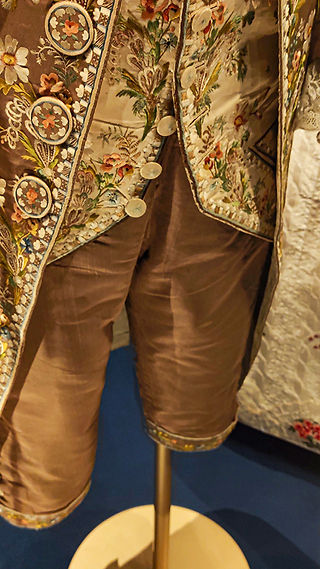


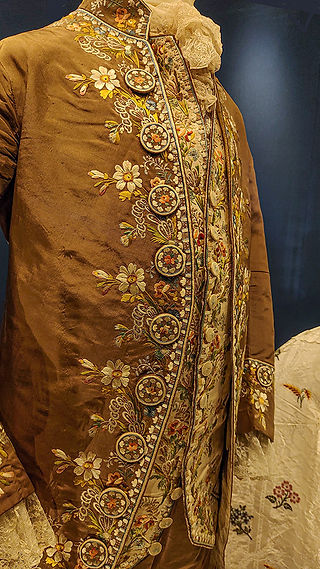


© Historic Royal Palaces, on show at Kensington Palace 2023
Silver - during the two research visits mentioned above I saw two similar court outfits of a very different style from those shown so far. Both stunning examples of the arts of 18th century embroiderer, button maker and weaver. They are silver lame doublets. One Probably worn by the Marquess of Camden at the Coronation of George IV, stored currently at Hampton Court Palace, the other worn by the 3rd Earl of Bute on show in the summer of 2023 at Kensington Palace.


"Silver lame, trimmed with silver braid. Decorated domed wooden buttons covered with silver wire, set in vertical rows. Deep cuffs (14cm) covered in heavy silver lace, each with a knot of looped ribbon (broad silver, narrow silver and cream plain weave silk). Fastening centre front with 9 buttonholes and 8 corresponding buttonholes. Lined cream plain silk weave."
- Royal Ceremonial Dress Collection catalogue text © Historic Royal Palaces


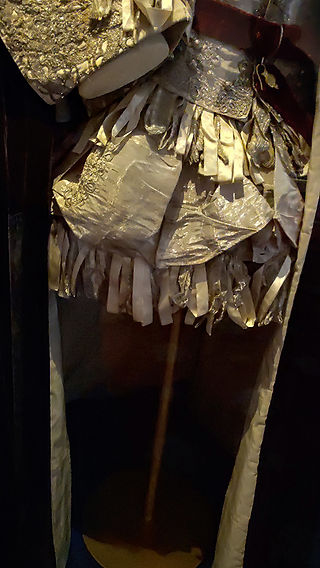


"Garter robes consisting of cloak, suit, gloves garter rosette and shoes, 1762. These robes were worn for his investiture as a Knight of the Garter in 1762. Bute was George III's friend, tutor and mentor. Allegations were made that Bute had excessive influence over the King. In 1771, Bute commissioned Sir Joshua Reynolds to paint a portrait of him in his robes. Amazingly, these robes survive exactly as pictured." This piece was borrowed from The Bute Collection at Mount Stuart.
-Exhibition text of Crown to Couture © Historic Royal Palaces, on show at Kensington Palace 2023
To see some images of comparable men's garments from Europe please see https://samlingar.shm.se/object/71696E81-3A0C-4820-9A57-9BD8DB8F914C
You can also see a similar piece going to auction here https://www.mellorsandkirk.com/auction-insights/the-coronation-of-king-george-iv,-1821-the-coronation-dress-of-a-peer/
Gold - as you will see in other posts (including the one about Whitchurch Silk Mill) Weaving Silk Stories is a project that began by relating the silk industries of Spitalfields, London with Whitchurch in Hampshire and Macclesfield in Cheshire. It was during an early research visit to Macclesfield Silk Museum that Kerry (one of the House of Embroidered Paper's volunteer team) photographed this stunning silk waistcoat.
Most of the garments above show, beautifully, the combining of related skills, those of the weaver and of the embroiderer for example. But the gold decoration you can see here is in fact woven into the fabric rather than being embroidered upon it. The skill is remarkable and therefore must be remarked upon.

© Macclesfield Silk Museum
Red - and just as it was possible to weave a pattern into the body of a silk fabric so it was possible to create a pattern in the body of a silk velvet fabric itself also. I took these images several years ago in the Fashion Gallery at the V&A.

1760-'69 © V&A
Mans formal coat 1760-69 Great Britain possibly of French silk velvet T.41-1958
Here is another in red:
Possibly French, Court suit of coat, waistcoat and breeches c 1760's Red and gold cut silk velvet at Bath Fashion Museum
"During the 1760's three-piece suits made of matching fabric had returned to fashion...This... example is made of red silk velvet, woven to create a textured surface in a small scale geometric pattern reminiscent of brickwork, and accentuated with stripes of woven gold thread...The suit demonstrates the fashion for buttons to be covered in the same material as the garment. By 1790, concern about the detrimental impact of this practise on the traditional button-making industry, prompted a revival of an historic act of Parliament to regulate dress. It imposed a penalty of £40 (more than £5000 today) on wearers of cloth-covered buttons. The result according to one commentator, was that 'soon they had all disappeared, and are now replaced by simple gold-plated buttons for Half Dress'."
- exhibition text Dressing the Georgians 2023 © The Royal Collection
Black and white - There was one last colour, pink and one last colour combination, black and white, that I noticed in particular whilst researching the history of the making and decoration of menswear. I will address the former in a post about the 1770s ensemble I knew I was planning. The latter would relate to the 1730s piece. In brief: all the beautiful buttons, embroidery and other decorative effects I'd seen on men's suits from the 18th century in particular bought to my mind the beautiful suits of the 20th and 21st century Pearly Kings and Queens. All of the garments shown above would have been worn by the very wealthy but I felt I couldn't only consider the heads of state and courtiers and politicians I needed also to consider the kings and queens of the working classes. Every man can decorate his suit even if he cannot afford a suit of silk and velvet, so Harry Croft (and the Costermongers) discovered. This seemed at first like later London history than that of the great Spitalfields silk era but I knew I wanted to at least nod to it, I would go on to find an older connection as I therefore explain in my post Metamorphosis For it would be with black and white in mind that I would progress my 1730's ensemble. I mention in my post titled Queen Anne Silver that as part of this project I have looked into and learnt more about eye sight loss as a problem amongst silk weavers in mills by speaking to various related charities. This taught me that certain, bold, colour combinations help people with certain levels of sight loss see text and imagery more easily. This made black and white another relevant direction to go in.
Weaving Silk Stories is a new project in partnership with the independent charity Historic Royal Palaces, which is due to launch in 2027.
Paper sponsorship by Duni Global


