
1770's - research & making - Song Birds and pink men
A detail from the history of silk in Britain
"From 1770 to 1800, an average of 490, 367 lbs of raw silk a year was taken to London. This was over four times as much as had been imported in the period 1710 to 1740".
A Royal detail
George III 1760-1820 - "...was the first truly British monarch of the Hanoverian kings. Ruling Britain was his first priority and he never visited his family's home in Hanover. He was a well-intentioned and cultured family man. Sadly, his personal and political life was dogged by recurring bouts of severe mental and physical illness, and he was declared unfit to rule in 1811, handing the throne to his son, the Prince Regent, when his health failed. His illness baffled his doctors and has fascinated modern minds." - https://www.hrp.org.uk/kew-palace/history-and-stories/george-iii/#gs.004fw3
Research
For this collection, in terms of menswear, I chose to consider the 1730's and 1770's in particular because:
1. Quite simply I had seen some truly stunning examples of male coats and frockcoats from these two decades. I'd also become interested in when the male "coat" became a "frockcoat".
Note: I have split the male coat research I did for this project
across three posts, this one, the one titled Metamorphosis
and another titled Decorated Men
Kensington Palace 2023 V&A Fashion Gallery 2022 Kensington Palace 2023 Royal Ceremonial Dress Coll.
Images © Historic Royal Palaces
2. The 1770's are central to the period of the reign of George III. Which places us just beyond the last use of Hampton Court Palace as a Royal residence. By this period the Palace was firmly established as a home for Grace and Favour residents one of whom was the father of the famously fashionable Beau Brummel who played at the palace as a child.
"By 1737, George II no longer wanted to use Hampton Court as a royal palace. It was quickly filled with grace and favour residents. Many of them were aristocratic widows in straitened circumstances, who were offered free accommodation in return for their husbands’ services to the monarch. The various apartments, although extremely grand, were not always the most comfortable places to live. Residents regularly complained that the palace was 'perishingly cold' and damp, and some had no access to hot water. Apartments continued to be granted as late as the 1960s."
3. The 1770's is an important decade regarding the production of silk in Britain because of the importance of the Spitalfields Act (1773-1824).
"There is no need to spend time in proving that the Spitalfields industry of the eighteenth century was mainly "capitalistic." The normal weaver was, and always had been, a wage-earner, though the masters were not infrequently recruited from among
successful weavers, and some of these masters were only in a small way of business. A typical manufacturer, during the whole
of the period 1760-1830, would either buy silk, possibly from abroad, more or less ready for the loom, or would have raw silk thrown, twisted, dyed, and in other ways prepared for weaving by throwsters, spinners, and the like, in various districts outside London. Spitalfields and the adjacent parishes were simply a weaving area, conveniently near to the landing-place and market
for the raw silk and to the greatest centre of consumption. That the trade was what would to-day be called an organised trade before the passing of the Act of 1773 is highly probable. For the Act was connected with difficulties arising from the faulty working of something very like a modern trade agreement in a piece-work industry. There was a "book," or list of piece-work
rates, "an agreed list," "that had existed long before I had existence," said an old foreman, by name Edward Jones, who
perfectly remembered the facts, which list was, "about the year 1767, broken in upon and violated." The antiquity of this
"book" would be a curious inquiry. Its breakdown produced the usual eighteenth-century expression of public opinion-an outbreak of brutal rioting... the result of the rioting was that masters and men met again and drew up a fresh list in 1769. Four years later came the first Spitalfields Act, 13 Geo. III., c. 68, whose main object was to prevent the recurrence of such troubles...All accounts agree as to how they did it. If committees of masters and men had not first discussed the piece-rates separately and then jointly, the Justices instructed them to do so. In the early days they generally managed to fix matters
up. The "magistrates of three jurisdictions always agreed to the same thing and the collective bargain was made binding. It
became a punishable offence to give or receive less or more than the duly sanctioned piece-rates...If the parties did not agree, the magistrates took evidence and heard counsel...The magistrates' decisions had at first been published in the papers. In 1874 they were collected into a book of fabrics and prices. The last version of this book appeared in 1806. "I have assisted," said a witness in 1818, "in forming all the list prices that have been made since 1784, a general one in 1795 [this was to meet the high prices of that year]; another in 1800; another in 1802; another in 1804; an explanatory one in 1805; and the last in 1806, a general one; and then by the desire of the masters and men I compiled the present book.".. Between 1780 and 1812 the Act was once imitated and twice extended....By...Irish Parliament for Dublin...for the London area, to include fabrics of silk mixed with other materials, such as bombazines and poplins..."
"Since the serious disturbances of the wearing of Indian calicoes in 1719...Parliament had passed...several Acts aiming to encourage and support silk workers however most of them were...ignored or eventually became invalid. As the tensions between masters and workers had grown to eruption points... [resulting from] ...dissatisfaction over pay among journeymen silk weavers, by... [the ] ...1760s, over 7072 looms were out of employments. Wages disputes, also known as “Spitalfields Riots”, broke out during the period of 1765 – 1769. Such tactics like the prohibition of calico wearing in 1721, regulation to protect and maintain the wages of journeymen at a reasonable level in 1773 or the provisions of working with mixed materials to female weavers were passed to improve the condition of silk workers."
4. The 1770's sit at the mid point of the life of the English wood-engraver and natural history author Thomas Bewick (c. 11 August 1753 - 8 November 1828) who beautifully etched the types of song birds that were kept and sold by Huguenot silk weavers whilst they worked in the attic rooms of the terrace houses in Spitalfields, London. Club row was a pet and bird market.
“The bird market … is attended from far and wide, but specially reflects the pleasures and habits of the neighbouring people of Bethnal Green, which turn largely on domestic pets; singing birds, rabbits and guinea pigs, fowls, pigeons, dogs, and even goats, are dealt in; any kind of animal that can be kept in a house or in a back yard”
These then are the main themes behind the inspiration for this piece, my 1770's frockcoat titled Songbirds
Frockcoats
To clarify then the history of the coat:
In the 1700s, a man's coat began to be commonly called a "frock" or "frock coat" around the 1720s to 1730s as an informal alternative to the more formal justaucorps. While it originated as a casual country garment, by the 1770s and 1780s, it had evolved into a widely accepted, fashionable form of day wear for town and, eventually, more formal occasions.
Key, milestones in the evolution of the 18th-century frock include:
1720s–1740s (Rise of the Frock): Initially a "frock" was a less formal alternative to the ornate justaucorps, characterized by a small, turned-down collar, reduced side pleats, and comfortable, functional design suited for country pursuits and riding.
Mid-18th Century: The skirts of these coats became particularly large and flared, sometimes leading to the term "frock" due to the skirt resembling a lady's gown.
1770s–1780s (Acceptance and Refinement): The frock became popular as "half dress" (between casual and formal) and was worn in town. By the 1780s, these coats featured high turned-down collars, large buttons, and tight sleeves with round cuffs.
Late 1700s (Transition): Toward the end of the century, the skirts of the frock coat started to be cut away in a curve from the front waist, acting as a precursor to the 19th-century tailcoat.
Important Distinction: While the 18th-century "frock" was a casual, often single-breasted coat, the formal, heavily tailored, waist-seamed "frock coat" (often double-breasted) did not become the standard, defining garment until the early 19th century (1815–1820s).
"The two main coat options for suits in this decade were the full-dress coat, or habit à la française, that developed a standing collar in the 1760s, or the more informal frock, or fraque, with a turned-down collar, known as a “cape,” that was taken up by young men on the Continent who were enamoured of English styles during the last quarter of the century (Figs. 1 & 2). Dress historian Aileen Ribeiro notes that in the 1770s (and even more so in the 1780s)...Beginning in the 1770s, the frock “was worn on all occasions [in England] except at Court” (Cunnington/Men 193). In this decade, both the formal coat and frock were generally single breasted with the double-breasted frock becoming more usual in the 1780s (Cunnington/Men 197)"
I do like this link for changes over time during this century:https://artsandculture.google.com/story/HAUBDcK7Flj0Lg
Song birds
Similarly to growing and displaying auricula flowers so the keeping of caged birds was a pastime enjoyed not only by Huguenot silk weavers but also royalty.
"During most of the 18th century, weaving was a cottage industry pursued in an essentially rural landscape of fields and hedgerows. Including in Spitalfields Huguenot weavers cultivated flower gardens and bred and trained singing birds..."
"The older houses inhabited by the weavers have wide latticed windows in the upper storeys, to light the looms. Being nearly all bird-fanciers, the weavers supply London with singing-birds, and half the linnets, woodlarks, goldfinches, and greenfinches sold in the metropolis are caught by Spitalfields weavers in October and March. They are fond of singing-matches, which they determine by the burning of an inch of candle. Spitalfields weavers are said to have extremely small heads, 6½ or 6¾ inches being the prevailing width, although the average size of the male head in England is 7 inches. We do not know whether the weavers still continue the old clothworkers' habit of singing at their looms, as mentioned by Shakespeare and Ben Jonson. "I would I were a weaver," says Falstaff; "I could sing all manner of songs." And Cutbeard, in Ben Jonson's Silent Woman, remarks, "He got his cold with sitting up late, and singing catches with clothworkers."
"The weavers sang religious songs whilst they were weaving, and kept canaries in cages so they could hear the birds singing as they worked."
"The Huguenots set up their own society in 1703, having an inclination towards floriculture and gardening. The remnants found nowadays near silk weavers’ windows suggest that they also had an interest in the breeding and training of singing birds. In ‘The silk weavers of Spitalfields and Bethnal Green’, Arthur (1931) described the Huguenots as such excellent citizenships being “industrious, small in physique, cheerful and quite in disposition, but very persistent, and with an inclination towards sound craftsmanship in each branch of their work…”
I found this idea fascinating. I had heard looms at work during my research and I now needed to imagine the sound accompanied by the twittering of songbirds. This was another layer to the sound track of a Huguenot weaver's life in the attic rooms of Spitalfields
In contrast, in the Royal Palace of Hampton Court and aviary was bult in 1700.
"Mary's collection of bird species started at Het Loo, the palace she and William built in the Netherlands. There she had a private kitchen and grotto, known as the Queen's tea room, which connected to a birdcage and her gardens. The birdcage may included ‘little green birds with red heads’ purchased by Mary whilst in Holland and was designed by William’s favourite William Bentinck. The designed was approved by Mary in 1688. According to inventories of the palace from 1713, the aviary also included a vulture, crane, water birds and many small bird cages within it."
Holly Marsden - AHRC CDP PhD candidate, University of Winchester and Historic Royal Palaces also writes:
"At Kensington, Mary had canaries, finches and other songbirds, though, as far as I know, there wasn’t a specific aviary. There were birdcages in her Gallery, though. Windsor had an aviary which kept exotic birds in the Rangers Lodge in the Little Park, but as you know this palace wasn’t really used by Mary and the birds were probably chosen by Admiral George Churchill. I haven’t found any herons or swans."
Note: what counts as a songbird?
The Countryside Charity lists some of Britain's most common songbirds here
Elsewhere I found mention of the Common Linnet the Woodlark, the Goldfinch and the Greenfinch.

Common Linnet 
Woodlark 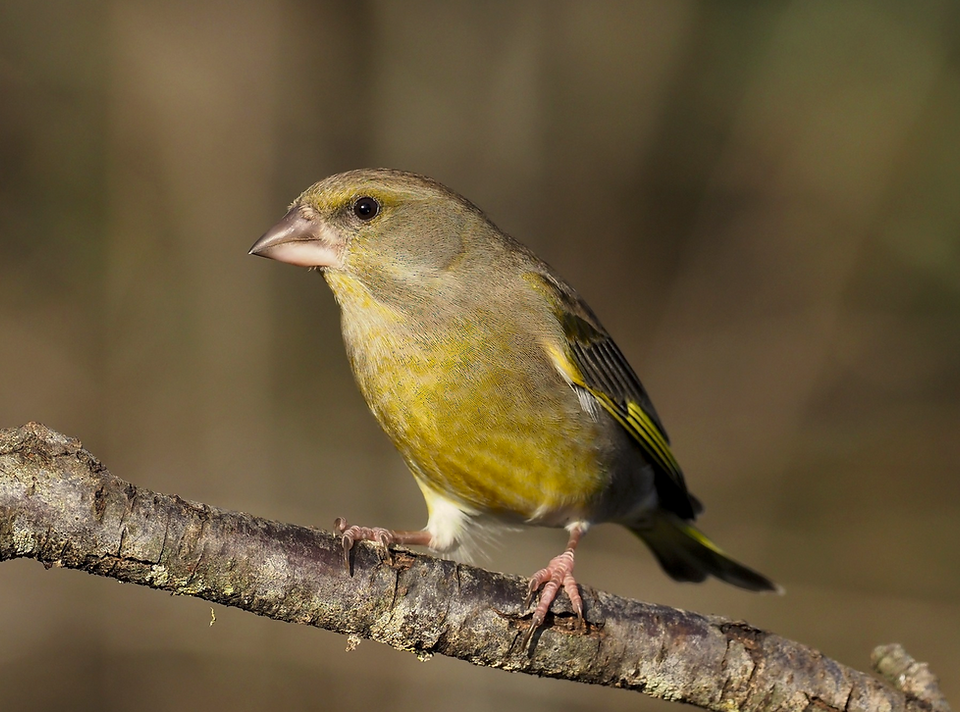
Greenfinch
I had spotted all of the colours of these birds in more than one male silk garment from the period during my research to this point, some of which you can see in the images above.
©The House of Embroidered Paper
I then began tracking and documenting many of the birds you find on lists of British songbirds. In the top row here you can see a sweet juvenile robin.
And a photo from the moment I was personally serenaded (or is he/she shouting at me?)
Of course generally wild birds have a tendency to be shy or at least fast moving. Perhaps they have ancestral memory of when their ancestors were kept in cages..
©The House of Embroidered Paper
I'll admit that my recording of different bird species was serving a dual purpose, inspiring both this piece and the future shape, no doubt, of the pieces in the 300 Years of shoes collection
For a nice link between song birds and silk please see: https://www.ourmigrationstory.org.uk/oms/huguenot-silk-weavers-in-spitalfields
Songbird Survival
It was about this time that I heard of the charity called Songbird Survival an independent charity that has been working since 2000 to solve the ecological crisis for songbirds.
"Our vision is to create rich, resilient and balanced songbird populations. We are the only national UK charity solely dedicated to changing the future for songbirds. We make an impact by driving conservation through scientific research, protecting songbirds by raising awareness and inspiring action, and safeguarding the most at-risk songbird species...Songbirds have charmed people for hundreds of years, boosting our spirits and health. They play a vital ecological role: dispersing seeds, promoting plant growth, controlling pests, and supporting a healthy natural environment. As sensitive indicators of environmental change, they also act as nature’s early warning system, alerting us when something’s going wrong...UK songbirds are facing unprecedented threats. Over the last 50 years, populations have fallen by 50% and continue to decline. Once common species - such as the nightingale and willow tit - have become rare sights and sounds. We live in an era of mass species extinction, driven by threats such as climate change, insect decline, pollution, predation and landscape changes."
-Tracey Spensley, Communications Manager, SongBird Survival
I asked for some specific information about some of the birds I'd begun to focus on:
"Woodlark (Lullula arborea)
Woodlarks are members of the lark (Alaudidae) family. They are quite secretive and most commonly found on heathlands in southern England. Woodlarks are a ground nesting bird and have a short tail and an eyebrow stripe. While woodlarks are green-listed, their relatively small population in the UK makes them susceptible to future losses.
· Estimated number of breeding pairs: 2,300
· 131% increase in numbers
Goldfinch (Carduelis carduelis)
Goldfinches are members of the finch family (Fringillidae) and are found all over the UK in gardens, parks and farmland. They have a distinctive red face and black wings with a striking yellow panel. They are a specialist seed feeder and their sharp bill is perfectly suited to removing seeds from plants such as thistles and teasels.
· Estimated number of breeding pairs: 1,650,000
· 152% increase in numbers
Greenfinch (Chloris chloris)
Greenfinches are members of the finch family (Fringillidae) and are found in woodlands, farmland and gardens. Males are apple green in colour with a flash of yellow on the wings and tail. One of the largest factors in the recent declines of greenfinch numbers is the trichomonosis outbreaks that have been occurring since 2005. This disease can be spread through close contact with other birds and sharing food and water sources and so keeping garden feeders clean is of upmost importance.
· Estimated number of breeding pairs: 785,000
· 66% decline in numbers""
The Linnet
Linnets are members of the finch family (Fringillidae) and are most often seen in small flocks in farmland and heathland environments. They are one of the smaller finches and the male has a distinctive red forehead and breast in the summer months. Linnets almost never visit gardens and prefer to forage for food on the ground in farmland areas.
· Estimated number of territories: 560,000
· 22% decrease in numbers"
-text from Songbird Survival
It was the pink of the linnet that particularly drew my eye. You can hear the Common Linnet sing on its Wikipedia page where it says:
"In 1758, the Swedish naturalist Carl Linnaeus included the common linnet in the 10th edition of his Systema Naturae under the binomial name, Acanthis cannabina...The genus name linaria is the Latin for a linen-weaver, from linum, "flax". The species name cannabina comes from the Latin for hemp. The English name has a similar root, being derived from Old French linette, from lin, "flax""
On that same page you can also learn that William Blake (1757-1827) invoked "the linnet's song" in one of the poems entitled "Song" in his Poetical Sketches. And to demonstrating the ongoing practise of keeping caged song birds in London in his 1840 novel The Old Curiosity Shop Charles Dickens has his heroine (Nell) keeping "only a poor linnet" in a cage, which she leaves for Kit as a sign of her gratefulness to him.
Pretty birds, linnets mix pink with shades of brown and green amongst white, black and brown: https://en.wikipedia.org/wiki/Common_linnet#/media/File:Linnet_from_the_Crossley_ID_Guide_Britain_and_Ireland.jpg

The first summer of this project I managed to get a shot of a linnet from some distance on a bird spotting guided walk at Rye Harbour Nature Reserve where you can see a huge variety of birds. I will keep trying to get closer.
Pink
With the beautiful breast of the male linnet in mind I started looking for pink in (male) historic fashion. Perhaps of all of the colours men wore historically pink might be the greatest surprise. About 20 minutes into this Dress Fancy podcast episode by Lucy Clayton (focusing on the Fashioning Masculinities exhibition held at the V&A in 2022: https://www.dressfancy.uk/fashioning-masculinities-the-art-of-menswear-at-the-va/ ) you can hear discussion of the inclusion in the exhibition of several pink pieces.
"During the second half of the century, embroidery becomes a common feature of gentlemen’s clothes, such as suits and waistcoats. The majority of extant examples are stitched in bright polychrome embroidery. In some cases, embroidery was completed on lengths of fabric and could be purchased and made up to your size by your local tailor. These embroidery designs ranged from delicate, muted borders to floral explosions in wild colors, such as...pink blossoms on purple silk satin." - from - https://romanticrecollections.com/blog
Because, in my work, I have also sought to reflect ideas such as memory, the fading thereof and the parallel fading of the colours of the garments we preserve in Museum stores I was particularly intrigued by the story you can hear in the recording above, told by the V&A curators about this portrait of Charles Coote, 1st Earl of Bellamont (1738–1800). Shown in his Robes of the Order of the Bath, 1773–1774 (borrowed from the National Gallery of Ireland for the exhibition) which would actually originally have been red. Arguably every physical object loses something of the sense of the truth of itself over time.

please click on the image to be taken to its source
The fading of robe and ribbons from scarlet to pink provoked questions in my mind about what Charles might have thought had he seen his portrait now. To try and work out whether he would have been horrified to see himself dressed in pink or whether he might have been happy enough I looked beyond the pieces I had seen in person and was surprised to realise that his reaction likely would not have too bad. For pink, it seems, has been historically a very fashionable colour in menswear. Here are some examples
please click on the images to be taken to their source institutions

Nottingham City Museums & Gall 
National Gallery of Victoria 
1756 ©The Met 
1746-'50 ©FAMSF 
1770-'80 © The Met 
© Museum of Fine Arts, Boston 
late 18th c. fashion plate 
By Arthur Devis (1712-1787)
You can see several examples collected on this page here: https://my18thcenturysource.tumblr.com/post/110590407302/inspiration-pink-menswear-in-the-18th-century
The V&A has an article about men in pink here
From pastel shades pink blends into the purple spectrum of course. For example this male outfit: https://collections.mfa.org/objects/445104/mans-formal-suit?ctx=688655e3-6d21-47ba-a1e9-8ed3f72d3f2c&idx=4
and as I began to decide I would combine pink and gold I came across this example: https://www.pinterest.co.uk/pin/319826011016132701/
And there is a pink suit held in The Royal Ceremonial Dress collection at Hampton Court:

From the 1770's/'80's from the Royal Ceremonial Dress Collection, Hampton Court
© Historic Royal Palaces
You can learn more about this garment here https://artsandculture.google.com/asset/dwEpfyvvcUpdsg
and this one https://artsandculture.google.com/asset/court-suit-associated-with-king-george-iii/KAFMXeJv40lwOQ

© Historic Royal Palaces
Because of a tendency toward (often highly complex) floral embroidered designs on male dress green was often used in combination with "prettier" shades. I saw this across many of the silk garments I looked at in my research. So I would need to consider whether to incorporate it also. Of course my slightly tongue in cheek use of the word prettier there no doubt says more about me and the era I grew up in than it does about the colour pink historically. Red was, and remains, a colour of power but pink in fact once:
"...shared its connotations of vigour and was worn freely by fashionable men – it was only in the first half of the 20th century that pink became associated with femininity."
In the 21st century when James Bond (Daniel Craig) attempted the colour and there was a hot (pink) debate about its appropriateness for male dress: https://www.telegraph.co.uk/fashion/style/can-a-man-really-get-away-with-wearing-pink/
In general pink has long caused debate: https://www.artsy.net/article/artsy-editorial-history-pink
You might think I am veering a little away from song birds but the success of the design would be all about how I combined these two attributes, the colour and the subject matter.
Early on in my research I found this print of a silk design in a design book in the collection at Macclesfield Silk Museum, dating to the 1960's/70's.

This design simplifies images of birds, makes of them just shapes and colour. This idea was what I would need to try and adapt if I was going to reproduce a bird shape using quilling as I had decided I wanted to. I found the two hundred year time gap between this bird graphic and the frockcoat shape interesting. I had begun with photos, moved to block printing and wanted, for my own education, to see illustrations of one or more of the birds in question (certainly the linnet) from the 18th century perspective also. So it was that, on the look out for images, whilst reading the following two posts by the Gentle Author of Spitalfields Life I learnt of the 18th century wood engraver Thomas Bewick:
You can learn more about him from The Bewick Society website with whose permission I can show you here his engravings of a Mountain Linnet (which has slightly different in colouring to the Common Linnet) as well as the Goldfinch, the Woodlark and the Greenfinch (to contrast with the photographs of these birds above, with which I began)

The Mountain Linnet, or Twite 
The Linnet, History of Birds 
The Goldfinch 
The Green Grosbeak/Greenfinch
You can also see more pages from his book A History of British Birds here: http://heddonhistory.weebly.com/thomas-bewicks-history-of-british-birds-1826.html and https://www.biodiversitylibrary.org/item/125460#page/205/mode/1up
A volume of A History of British Birds was bound for George IV: https://www.rct.uk/collection/1055618/a-history-of-british-birdsnbsp-v-ii-containing-the-history-and-description-of
I also found this beautiful illustration of a goldfinch by Maria Sibylla Merian whom I refer to further in my post Mulberries in Fournier street

Goldfinch on a branch bearing Fig-like fruit, from an album entitled 'Merian's Drawings of
Surinam Insects &c'; and with an example of a brown moth Watercolour, touched with bodycolour, on vellum circa 1693-1700
© The Trustees of the British Museum
Design
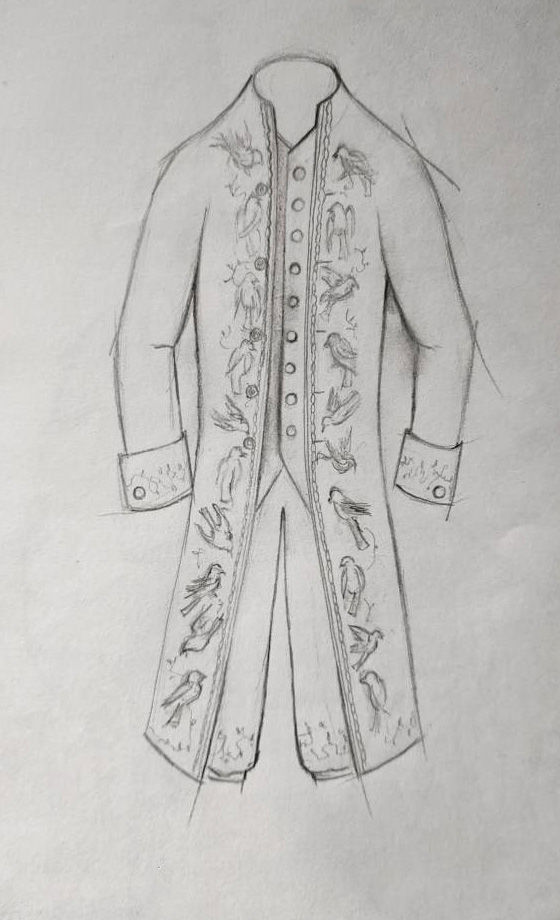
This was my design (I must ask you to imagine gold, pink and possibly green):
Making
So I began quilling songbirds, combining the stylisation from the silk weaving design in the Macclesfield Museum collection above with, I hope, the decorative/gilt aplomb of the 1770's frockcoats I had been looking at. Whilst you can see in my sketch for the design of this piece I had begun thinking they would be seen to be flying but the spread of their wings proved too great (or the overall bird got too small) it seemed. So they became seated, much more sedate and surely more reflective of their unfortunate captivity, in cages sat beside and singing to the Huguenot weavers.
Their placement in a line down either side had been inspired by this piece
From the Court to Couture exhibition at Kensington Palace 2023
© Historic Royal Palaces
And the braid I would add would be likewise.
I looked at both the shape of the leaves in the Macclesfield design and the shape of the lines and leaves on this stunning garment (below) from the Royal Ceremonial Dress Collection. So they became long and slim. The shape of each bough I created was to be caging the bird somewhat.

Images © Historic Royal Palaces
As you can see (above and below) I was also very inspired by the buttons on this piece. You can see the full details and more images of this beautiful garment and all the others on this page in my post title Decorated Men.
And so, experimenting for myself, I started exploring how I would look to make buttons for both the frock coat I was working on and the necessary waistcoat beneath.
The House of Embroidered Paper volunteer team also began quilling tiny bright pink and green flowers.
I had found that colour combination again here:
Images © Historic Royal Palaces
For the floral design on the waistcoat I began by looking at the design of the silk waistcoat made for William Wilberforce held at Henfield Museum. For more information about this please see my post Decorated men.
That got me to here:

I had certain practical decisions to make about the details when it came to the final look of the frockcoat.


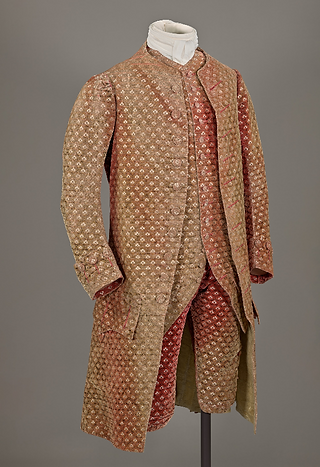
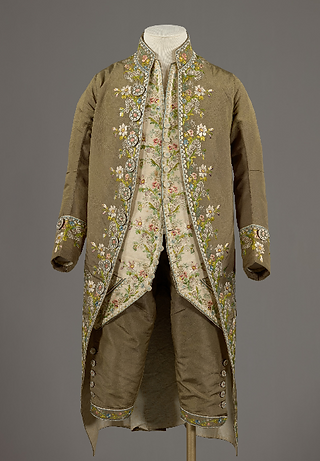
You can see from these four in the Royal Ceremonial Dress Collection that there was no standard in terms of the number of buttons down the front ( 9 - 11 appears common), whether those buttons had accompanying buttons holes (sometimes yes, sometimes no) and whether there was a slim collar or not. I decided on having a collar, having 10 buttons and no buttons holes. Images of the whole piece will be available from its first exhibition in 2027.
Weaving Silk Stories is a new project in partnership with the independent charity Historic Royal Palaces, which is due to launch in 2027.
Paper sponsorship by Duni Global


