
1820's - research & making - Cloth of Gold - leaving Spitalfields and mechanisation
Updated: Jul 4
A silk detail
"From documents of unquestionable authority it appears that, in the year 1770, the annual supply from Bengal and China was about 100,000 lbs. weight only; that in 1780 it amounted to but 200,000 lbs.; that in 1800 it was 292,585 lbs.; and that in 1820 it had increased to upwards of one million pounds: which, added to the amount of raw and thrown silk drawn from Italy, will give a total of silk imported into Great Britain, in the year 1820, of 2,547,212 lbs. weight: exhibiting a two-fold increase during the space of twenty years, and greatly exceeding the Consumption of the French manufactories.
"That, important as this manufacture is acknowledged to be, and much as it has recently been extended, it is still depressed below its natural level, and prevented, by existing laws, from advancing to a far higher degree of prosperity than it has hitherto attained; and which, under more favourable circumstances, it would, without difficulty, realize. Possessing, as this country does, access to an unlimited supply of silk from its eastern possessions, an indefinite command over capital and machinery, and artisans whose skill and industry cannot be surpassed, your petitioners hesitate not to express their conviction, that, by judicious arrangements, the silk manufacture of Great Britain may yet be placed in a situation ultimately to triumph over foreign competition; and that silk, like cotton, may be rendered one of; the staple commodities of the country..."
From Spitalfields Silk Manufacture Acts - petition for the repeal therof
HC Deb 09 May 1823 vol 9 cc143-50
Spitalfields weavers had been seen as supporters of radical politics from John Wilkes, to the Gordon Riots in 1780, to the London Corresponding Society in 1790s, to the campaigns for extension of the franchise in the 1820s...
A Royal detail
George IV - was King of the United Kingdom of Great Britain and Ireland and King of Hanover from 29 January 1820 until his death in 1830.
Research
In this post I am looking to tell two stories. One is about the gradual decline of the silk industry in the Spitalfields area of London and its spread to other parts of the country because of the start of mechanisation in the early 1800's. The other is about the silk worn by royalty as they are crowned.
The opposition that the weavers of Spitalfields faced, from France and Italy, had always been present but from 1825 this increased again due to changes in the law and mechanisation, so the industry in the area went into steady decline. This saw an increase in the spread of hubs of silk weaving however, in towns elsewhere across the country:
"By the 1820s, Jacquard technology had spread to Britain"
From home working to silk mills - London's loss was a gain to other parts of the country:
"It was to keep pace with the times and update their machinery and working conditions that many of the leading London manufacturers started up looms and factories at Sudbury, Braintree and other places in Essex. No doubt it was this growing trend that influenced William in his decision [to relocate]...from Bethnal Green to Bocking near Braintree. Messrs. Daniel Walters and Company were a very successful firm of silk weavers, particularly in the field of furniture brocades of which they were exporting an immense quantity annually to America and the Colonies. Under William Folliott's design influence they went from strength to strength."
"...the abandon of industrial technology, which lasted fifty years, also plays an important part in the fall of Spitalfields’ silk industry. Spitalfields’ silk weavers, were once called the “London’s Luddites” for their long-term fight against mechanisation. It was undeniable that the invention of ‘Jacquard’ machine had led to the replacement of many male weavers. Though, the refusal of machines was also guaranteed for the failure in competition with other high-flying silk industry in Yorkshire or Lancashire at that time."
My plan was to include references to some of the mills that were coming on stream (literally, in the case of Whitchurch Silk Mill, for it is water powered) in the 1810's-1820's. Not only logically because it was pivotal to the change in direction the history of silk in the UK underwent during that time period but also creatively because I wanted to feature imagery of the cog and wheel mechanisation of looms at the centre of the skirt of a dress. A dress that would mark the period when:
"In the early nineteenth century the industry was spreading far beyond Spitalfields. The statement made by an employer in 1821, that "a few years ago the silk manufacture was hardly known beyond London," was no doubt exaggerated; but there was certainly in these years an extension of the weaving industry in such places as Braintree, Bocking, and Coggeshall; Sudbury, Lavenham, and Haverhill; Reading, Newbury, Andover, and Whitchurch. The practice in these districts was to pay only two-thirds of the Spitalfields prices. Further afield were Coventry, with its ribbons; Norwich, which did a large trade in mixed goods of wool and silk, especially bombazines; Macclesfield, whose original trade was in silk handkerchiefs; and other Northern districts, now including that of Manchester, which was competing with London in various lines. As the law stood, a London manufacturer was not allowed to put work out in the neighbouring counties; but, certainly after the peace and perhaps before, this rule was evaded. If the capitalist could himself move, say, into Essex, there was nothing to prevent his still giving out work in Spitalfields; but many of them managed to give work out in Essex without deserting London, "of course conducting" their country businesses "under other names." There were some convictions for this breach...but not enough or decisive enough to stop the practice. No doubt this country competition made some employers, during the second decade of the nineteenth century, increasingly impatient of the Acts. Their impatience was stimulated by rapid changes of fashion, especially the introduction of new French fabrics after the peace, and the difficulty of creating or adjusting legal piece-rates in time to catch or retain new lines of trade."
Silk People
And I wanted to find certain individuals, whose lives were threaded through with silk weaving whose journeys I could follow.
1 - William Maddick
In the post I wrote about Whitchurch Silk Mill at the start of my research for Weaving Silk Stories you can read of how William Maddick, moved his manufacturing in 1917 to Hampshire, after doing his apprenticeship in London. Later on he moved his work and life to Macclesfield. It had a triangular journey - London (Spitalfields), Whitchurch and Macclesfield. It was William who started me on my own silken path.

Whitchurch Silk Mill
2 - Stephen Wilson

This is a "London rarity. A former silk mill, complete with cupola, built c1820. Manufacturer Stephen Wilson set it up in an attempt to convert the Spitalfields silk-weaving industry to the factory system established. The mill's buildings were subsumed into P.B. Cow's India Rubber Works (as in Cow Gum) early in the C 20th. Much of the site was demolished in 1989 prior to conversion to a supermarket (by David Gibson Architects). Grade II listed it is within the Streatham Common Conservation Area and is now a Sainsbury's.
By the time I saw the images of Wilson's factory shown above I had in fact already come across the name Stephen Wilson in relation to no.19 Fournier Street as part of some research I was doing with the researcher at the Huguenot Museum in Rochester. He had found out for me about Judith Signeratt and Co silk weaver's based in No. 19 in 1743, using the attic to house their looms as all the weavers did, and about Gideon Bourdillon who moved in next door (no.16) two years later. They formed themselves into a new company forthwith known as:
"...'Sequeret and Bourdillion Co.' by knocking through to join the houses and staffing fourteen of heir workmen" - https://www.shadyoldlady.com/location/2935
Note: It's interesting to look at a will from one Stephen Signeratt dated 1719, possibly a predecessor
of our Signeratt of Fournier Street, from the same area and involved in silk. Stephen's
legacies in his Will are very high for 1719, he must have been very successful.
1719 Stephen Seignoret Will -
£100 to servants for mourning; £50 to Churchwardens of St Gregory
Church for the poor, £100 to Directors & Governor of Christ Church
Hospital; £50 to Charity School of Richmond; £100 to Poor French Protestant
Refugees; £50 to Charity House, Spitalfields; £50 to House of Charity
in Soho; £200 to Deacons of French Church Threadneedle Street; £200 to Elders
of French Church of St Martins Lane; £600 to Governor & Directors of
French Protestant Hospital; 3 Annuities of £42, £14 and £14 to French
Protestant Hospital; 2 x £100 Annuities to my wife Elisabeth; also annuities of
£84, 2 x £50, 4 x £20, £40, £25, 2 x £14 and £72 to my wife; 5 Annuities
of £24 on lives of my wife and Bartholomew Philibert; £12,500 to my wife,
£500 immediately after my decease; £12,000 6 months after my decease
to my wife her furniture and what ever due from her brother Salomon
£1000 to my niece Suzanne Ravand, daughter of the late Ferdinand Ravand;
£6000 from her grandmother Suzanne Signoret widow of Marc Anony
Ravand; £1000 to my nephew Marc Antony Ravand; £200 to my friend James Robithon
£200 to my friend John Robithon; £200 to wife of my friend John Robithon;
£20 to Margaret, widow of Orphas Tintot? £10 to Mart Orphas
Tintot her son and to Mary Polissary, widow of Simmonet Dobel at Lyon all the funds
she owed me. My nephew Peter Signoret, Merchant to be my Executor
But between 1766 and 1773 the two houses in Fournier Street were occupied by satin weaver Daniel West, whose daughter Ann married silk manufacturer Stephen Wilson. They lived there from 1778 to 1798.
19 Fournier street was separated again, from no. 16, in 1824 but:
"The legend goes that the silk for Queen Victoria's coronation gown (1838) was woven here."
It was amazing that the research for this piece had taken me to a royal connection and a coronation no less.
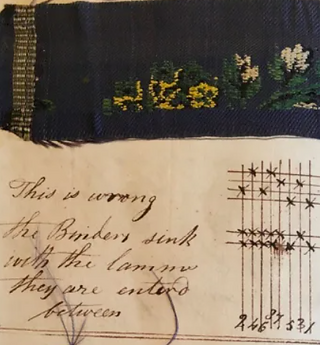
I then came across a post in the Spitalfields Life blog about the apprenticeship ledger of one Samuel Wilson created during his time apprenticed to his brother's firm (beginning 1806). I thought the combination of visuals (below), the colour combinations and notations beautiful and might be something I would incorporate into the piece. The marking of the placement of threads and the crosses marking particular places of warp/weft cross over reminded me of the musical notes I had replaced with stars around the edge of the train of my court dress Symphony of Stars made for The Royal Pavilion. I already meant this dress (Cloth of Gold) to be a partner piece to that one and I was beginning to see more and more parallels. Samuels brother's firm was called Lea & Wilson of 26 Old Jewry, Cripplegate, and his brother's name was Stephen Wilson: https://spitalfieldslife.com/2018/10/01/samuel-wilsons-ledger/

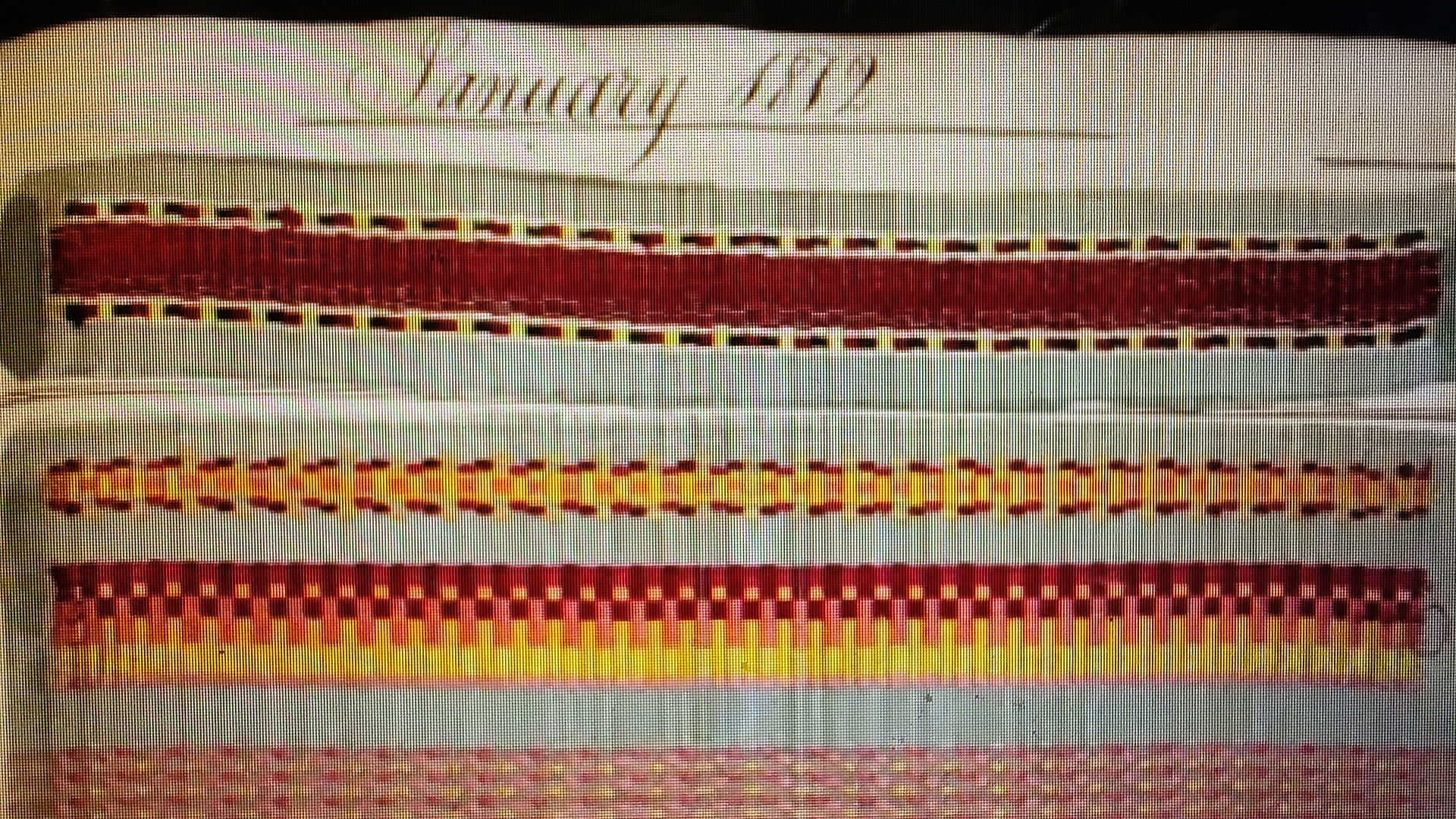
House of Embroidered Paper volunteer Kerry started inkle loom weaving at this stage to see if we could mimic any of his designs.

Now I have to be careful here. Research is hard and I am not a professional researcher. Was I looking at various references to the same Stephen Wilson. I wasn't sure the dates aligned. The first Stephen Wilson lived in Fournier street from 1778-1798 (or possibly from a few years earlier according to this site) whilst the second Stephen had a brother (Samuel) who was born in 1792. The fact that Samuel was apprenticed (at the age of 10 it would seem!) to his brother's, already established, company made me wonder if these two Stephens could be the same person. Perhaps his brother was a bit older (son of a first marriage?). But otherwise there were two Stephen Wilson silk manufacturers in quick succession in the area, the mill having been set up by one of them. It was not an uncommon name. There was another Stephen Wilson born in 1777 and it may be that the first one I heard about is the one to whom this will belongs, it being dated to 1814 too early to relate to the mill builder. Another reference to a Stephen Wilson also related to silk, can be found here.
Samuels Wilson's ledger was written between 1811 and 1825. Perhaps there were 5 years before his apprenticeship could be made official when Samuel reached or was nearing the normal age of 16. Apprenticeships didn't usually last as long as 14 years but perhaps his records simply flow into his continued working for the same company. In his ledger:
"The opening pages are devoted to a discourse on how to create a perfect woven circle and the many minor adjustments to the ‘tyes’ and ‘sett’ that Samuel had to make on a loom to achieve this. It reveals the remarkable technological changes weavers experienced in the first three decades of the nineteenth century. Part-way, the ledger includes patterns for silk scarf designs. A tantalisingly small cutting of a hand-woven red and yellow silk for ‘chair bottoms for one of her majesty’s rooms in the Castle Windsor’ in 1816 is pinned carefully to the left-hand corner of a page.
Samuel Wilson’s apprenticeship record is a rare discovery that offers a unique view of the workings of the London silk industry in his era. More importantly, Samuel shares his own experiments and personal findings alongside accounts of disputes over weavers’ pay, dye recipes and client orders. The fabric samples and text are of great interest in their own right, but together they comprise an exceptional window into the development of a period in London’s textile history that is largely neglected. Through his personal ledger, we can read Samuel Wilson’s personal thoughts and hear his voice too.
I also found a Stephen Wilson referred to in the article about The Spitalfields Acts, 1773-1824 by J.H Clapham where he was described as...
""...Another witness, Stephen Wilson, a thorough going enemy of the Acts..."
Note: The Spitalfields Act of 1773 mandated that local magistrates in
designated silk-manufacturing districts, but not in the country, set the
"wages and prices of work" masters could offer journeymen. In practice
it actually controlled the piece-rate price of goods produced by labor.
The exact rate masters could pay journeymen was set, with no leeway.
Paying above or below the price subjected the master to severe fines.
Work done with machines was paid at the same rate. One could only
have two apprentices, (presumably to keep down the number of workers
paid apprentice wages).
This is likely our mill owner because Wilson pointed out how the Acts hindered mechanical improvement. Masters had to pay the same rates whether labour-saving appliances were used or not.
"So, of course, labour was not saved. Such a law in the cotton trade, said Wilson, would have ruined Arkwright." - https://www.jstor.org/stable/2221846?seq=8
But Wilson...
"...had seen an example of the loom while a prisoner of war in France from 1803-1807. He gained his freedom after his wife Sarah petitioned Napoleon for his release. After returning to England, from 1810 to 1820 Wilson seems to have been engaged in finding a Jacquard loom that could be shipped back to England. This would have been difficult as few of the looms were being built in this early period, and all would have been regarded as very valuable strategic business property..." - https://historyofinformation.com/detail.php?id=4726#:~:text=Wilson%20built%20a%20large%20silk,History%20of%20Western%20Textiles%20(p.
"Stephen's attempts to introduce the Jacquard loom into his company are seen in a letter sent to him, in August 1820, from Paris, by a Thomas Smith. The letter has all the appearance of being from an industrial spy. Smith described his visit to one of the largest manufactories in the environs of Paris and his examination of 'the machine'. He described the technology of 'the machine' and concluded by saying, 'I have also obtained a Hook as you desired - and also a small bit of the Paste-board [composition of the cards] to show its texture' "
This Stephen Wilson lived opposite where he built his large silk mill in Streatham in 1820. It was meant for production of silk woven by Jacquard looms.
"He also smuggled a French weaver into England to teach Wilson's employees how to use the looms. According to The Cambridge History of Western Textiles (p. 793) the earliest surviving Jacquard-woven patterns in England date from 1825, though there is a design for a handkerchief of 1823, "but the collapse of the silk industry in 1826 made the introduction abortive."
https://historyofinformation.com/detail.php?id=4726#:~:text=Wilson%20built%20a%20large%20silk,History%20of%20Western%20Textiles%20(p.
I will leave unwoven for now any/my own certainty over which Stephen Wilson is which. You can see some images of beautiful examples of Jacquard looms in Paradise Mill, Macclesfield in my blog post here showing that by1860 when that Mill was established the Jacquard loom had found a firm foothold in Britain. I also talk about the Jacquard loom itself more generally in the post about the dress called Looming.
I want to admit to a personal interest in the name Wilson as it was my mother's maiden name and it joins my grandfathers family with my grandmother's whose heritage may (or may not) have been Huguenot (still inconclusive but researched in depth with a researcher at The Huguenot Museum in Rochester. I will present it all fully in its own post but as a quick overview: there had long been a family rumour (told by my mum to my brother and me) that amongst our ancestors on her side a French Count married a gypsy lady. My father named our childhood home Romany, perhaps in honour of this (I can't ask him now). My grandfather Wilson married into the line of family members whose ancestors angelized their French name to Shoppee from Chapuis (sometimes Chappuis). And we know that on the 18th February 1717 one of my ancestors, Bartholomew Chapuis, was apprenticed to one Paul Gandon, Weaver as can be seen evidenced in the records of the Weavers Company. I like to think he might have been weaving silk for the inhabitants of palaces such as Hampton Court to wear.

I want to include as inspiration for this dress another four Huguenot silk designers who I have come across (two of whom were brothers) as well as a single house is Fournier Street Spitalfields, a road name I have mentioned in other posts, located as it was at the very heart of this silk weaving area in the 1700's.
3 - William Folliott
With this piece we are going for gold but I want to look again at the silk weaver William Folliott, whom I mentioned in my post titled Queen Anne Silver. That is, William Folliott the father (who I will mark as the II not because he was called as such but just to help prevent confusion as you will see), b. 1805 (the year of the Battle of Trafalgar) and apprenticed in 1821. His son, William Folliott (III) was b. 1835. His father, William Folliott (I), was a shoemaker William (I) apprenticed his son William (II) to one John Louvel, to serve as an apprentice weaver (a month later he also indentured him to a blacksmith! But I talk more about that elsewhere). William (II) followed through his seven year apprenticeship in weaving, finishing therefore in 1827 and no doubt heavily influenced by the evidence of the weaver's art all around him in Spitalfields.
It was indeed common for skills to be passed on. And the Huguenots in London were a tight knit community:
"Various branches of occupation in the silk manufacture would be carried on under the same roof, by different members of the same family. It was very typical for a family to have eight out of ten members directedly engaged in the employment of silk...According to an anonymous author in 1804, in the silk manufacture, a father and his sons usually took charge of the operation of machines...tasks that required less physical strength like reading card slips, casting, drawing, warping silk and weaving, fell to mothers and her daughters."
But by:
"...the first quarter of the 19th century, silk weavers’ conditions grew pitiable indeed with the weekly earning of mere 5 shillings. As the industry fell in to decline in the 1820s, Spitalfields gained its reputation as a cheap area, which resulted in...numerous waves of immigration. With the rapid population’s growth in such...economic hardship, degradation of the already awful living conditions of Spitalfields’ silk workers was an expected tragedy."
In the country more generally 1820 and the start of 1821 were tumultuous times for parliament, which was prorogued for the first time in the 19th century following machinations and debate about the place of Queen Caroline and the Royal marriage in relation to the nation's ministry. The effects were felt across the country:
"A county palatine of seven hundreds, separated from North Wales by the River Dee and from Lancashire by the Mersey, Cheshire’s fertile plains were bounded to the south and east by Shropshire, Derbyshire and Staffordshire. It had industrialized early, and between 1821 and 1831 its population increased from 270,098 to 332,391. The incorporated city of Chester, the county and election town, returned two Members, but...the silk towns of Congleton and Macclesfield and the burgeoning textile town of Stockport, famous for its calicoes, remained unrepresented."
Note: You can read more about silk weaving in Macclesfield
and the involvement in that industry of MP John
Brocklehurst in my blog post on Paradise Mill
The coronation of George IV as King of the United Kingdom finally took place at Westminster Abbey, London, on 19 July 1821 and the silk he wore would appear worlds away from the sense of poverty being experienced by the silk weavers of Spitalfields and elsewhere. At this time in British history the aristocracy were viewed somewhat like exotic birds or mythical creatures by the working man and woman.
William (II) passed his skill on to his son William Folliott (III) and this William links us back to Royal coronations. He who would go on to have a fascinating career. Becoming (at first) a partner and later (due to it's being a bad partnership) manager and chief designer of Messrs. Daniel Walters and Company in Braintree. It was in 1901 (as mentioned above) that this firm would be given the task of weaving the coronation robes for the crowning of Edward VII:
"The following extracts from the magazine 'The Queen' of the 8th March 1901 give us an excellent picture of the scope of the work undertaken...Messrs. Warner and Sons, of Braintree, in Essex and 9 Newgate Street, London are busily employed weaving the splendid cloth of gold for the mantle which our King will wear at the Coronation, and they have also a fine show of brocades suitable for Royalty and the peeresses. (Authors' note:- In the same article there appears a photograph of William Folliott at the Loom weaving the cloth of gold mantle for the King's Coronation). The article continues: 'The same firm is busy with the Coronation velvets in the purest possible silk; imperial purple for Royalty and a lovely soft crimson for the subjects of the King. It was a wise decision that in every case the petticoats should be either white or cream, for this throws up the colour as nothing else could: nothing better is issued from the looms. But with the thousands of grooved wires and silk threads and the number of times it is necessary for the shuttle to pass to and fro, the production is naturally slow, and only a very few yards can be made in a week by the most hard working craftsman. As far as the beauty of design, there can be no doubt that England is proving herself equal to any demand put upon her; and, furthermore, our native silks are perfectly pure, entirely unweighted, and most lustrous in their sheen." https://www.cawcutthistory.com/docstore/William%20Folliott%20Biography.pdf
Note: the passage above decided the white colour of the front of this dress
William Folliott's work is recorded in the archives of Warners: https://warnertextilearchive.co.uk/our-history/
An example of his silk can still be seen in the V&A archives: https://collections.vam.ac.uk/item/O86344/conchus-sample-william-folliott/
Note: As we have seen in other posts individual Huguenots with expertise
rose to prominence in many fields. They were involved in every area of
craftsmanship that I am concerned with in my research. There is a
Huguenot connection
stemming from the 1820's that directly involves paper and the
coronation of King George VI and Queen Elizabeth. Robert Riviere,
a famous book-binder of Huguenot descent "...founded his company in
1829 and it continued to trade until 1939. One of the last commissions
it undertook was the binding of the Bible and two Books of Common Prayer
produced for the coronation in 1937. However, the specially-bound Bible
was not actually used as it proved too heavy for the frail clergyman to hold,
and on the day a plainer Bible was substituted."
William Folliott (III) would overcome the problems of poverty caused by a decline in his industry by working first for Messrs. Norris and Company, Spitalfields, a company of silk weavers supported by royalty and descended from the original Huguenot refugees that would manage to buck the trend and hang on to the reputation it had built over the years for weaving first class silk damasks, brocatelles, poplins, etc. specifically for curtains and other upholstery purposes. In her short biography of William Folliott (III) Elfrida Sellic tells us that Messrs. Norris and Company were:
"...awarded First Class Medals in the London 1851 and Paris 1855 exhibitions, their brocades and brocatelles being extensively used by various Foreign Courts and at Windsor Castle. It was in this environment that William Folliott's talent for design was encouraged..."
When he was 27 William (III) won the Gold Medal of the Royal Society of Arts at an International Exhibition for a chair seat upholstery design of gold roses on a scarlet background. After Messrs. Norris and Company he would decide...
"...to go into business on his own account... From then on it appears his talent for design grew and his work became more and more prolific until in 1872 we find he was in touch with the South Kensington Museum (now the V&A) with a view to contributing some specimens of his work in silk to the branch Museum at Bethnal Green (still in existence as an offshoot of the V. & A.). In September 1872 his offer was accepted; a letter dated 10th September from G.F. Dunscombe, Director of the South Kensington Museum stated: 'I am directed to inform you that the authorities of the South Kensington Museum have pleasure in accepting your kind offer to contribute a collection of specimens illustrative of the silk manufacture for exhibition at the Branch Museum at Bethnal Green.' In December 1872 the offer was made un fait accompli. A letter dated December 21st from F. Coles, Director of the Bethnal Green Museum states, 'Dear Sir, I have exhibited six frames of your silks and shall hope to have the remaining two in their places by Tuesday...At some time between 1885 and 1892 William Folliott took a very important step in his career; he became a partner in the firm of Messrs. Daniel Walters and Company of Braintree, Essex.." - https://www.cawcutthistory.com/docstore/William%20Folliott%20Biography.pdf
4 - I want to mention one other person here, in relation to reflecting on the conditions workers suffered in mills. Her name was Caroline Elizabeth Sarah Norton, Lady Stirling-Maxwell (née Sheridan; 22 March 1808 – 15 June 1877).
Caroline was an active English social reformer and author. She left her husband, who was accused by many of coercive behaviour, in 1836. Her husband then sued her close friend Lord Melbourne, then the Whig Prime Minister, for criminal conversation (adultery). Her father Thomas Sheridan... .
"...was an actor, soldier and colonial administrator, the son of the prominent Irish playwright and Whig statesman Richard Brinsley Sheridan ... "
In 1817 he died in South Africa while serving as colonial secretary at the Cape of Good Hope and his family was left almost penniless.
"...Prince Frederick, Duke of York and Albany, an old friend of her grandfather, arranged for them to live at Hampton Court Palace in a "grace and favour" apartment for several years....The combined beauty and accomplishments of the Sheridan sisters led to their being collectively referred to as the Three "Graces"
Caroline became interested in social reform and wrote about working conditions including for mill workers. She wrote the poem - A voice from the factories: https://digital.library.upenn.edu/women/norton/avftf/avftf.html
Royal coronations
Thus it was that William (III), the third silk weaver I have related to this piece (Cloth of Gold) would find himself involved in the making of the Royal robes of coronation. But lets take a step back to look at what is still worn today by the monarch at their coronation that would have been worn in the early eighteen hundreds by George IV and see why I decided to call this dress Cloth of Gold.
Note: 'Tabby' originally referred to a kind of
silk taffeta with an irregular wavy finish
The coronation robes are all cared for by the Royal Collection Trust
The one that links most directly with the title of this post and of the dress I plan to make is the coronation mantle:
"A coronation mantle of cloth of gold woven in coloured threads with a pattern of emblems in a curvilinear pattern of foliage, crowns, fleur-de-lis and eagles with coloured roses, thistles and shamrock woven over, and with gold fringing and lined in red tabby silk. The gold clasp, which closes the mantle at the chest, is cast in the form of an eagle. The Imperial Mantle, also known as the Pallium or Dalmatic Robe, was made for the coronation of George IV in 1821. The design of this example was based on earlier Mantles, which may be seen in portraits of the Tudor and Stuart monarchs, but in origin it is based on a priestly robe, and its form has changed little since medieval coronations. This link with priestly robes was a reminder of the divine nature of kingship. The sovereign is robed in the Mantle in the investiture part of the coronation ceremony...After this the sovereign is dressed in the Supertunica and Stole, with the Mantle on top...The silk for George IV's Mantle was supplied by two mercers - William King and Philip Cooper, and the robe was made by the tailor John Meyer for £24. The royal goldsmiths Rundell, Bridge and Rundell created the 'elegant chased golden eagle' to form the clasp"

©Royal Collection Trust 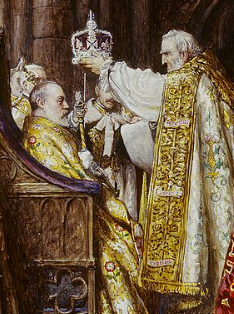
Edward VII 
Elizabeth II 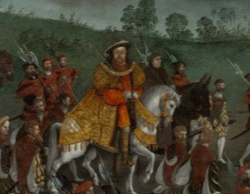
© Royal Collection Trust 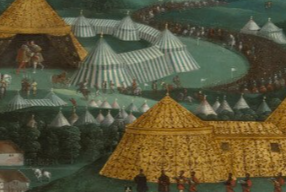
© Historic Royal Palaces
Above (left) you can see Edward VII and Elizabeth II wearing the same cloth of gold over the garment called the Supertunica.
In fact I first came across the title 'cloth of gold' in relation to Henry VIII and the grand tournament held 300 years earlier (1520) to celebrate peace between Britain and France. Above are two details from a painting of the same name recording the event. To read more:https://blog.nationalarchives.gov.uk/the-field-of-the-cloth-of-gold-1520/ and
You can see this event and the name Cloth of Gold is referred to at Hampton Court Palace.
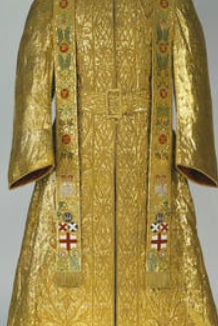
At their coronation the monarch wears also a Supertunica. Usually solid gold it is:
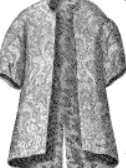
"...a robe worn by a British monarch at their coronation...donned shortly after the Anointing ceremony for the vesting of the Spurs, Sword of Offering and the Armills. Afterwards the Stole Royal and Robe Royal are worn on top of the Supertunica for the crowning of the monarch. The Supertunica, Stole and Robe are replaced with the Imperial Robe for the final procession from Westminster Abbey."
James II 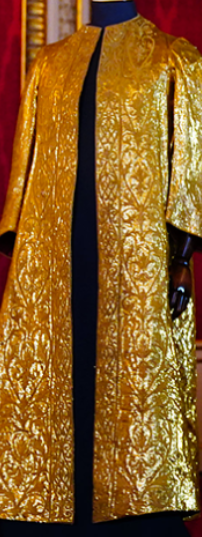
George V 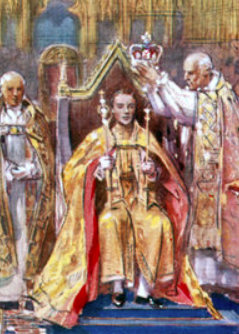
George VI 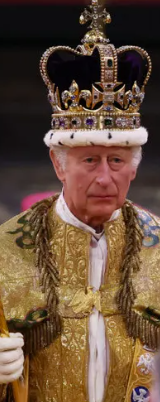
© Royal Collection Trust 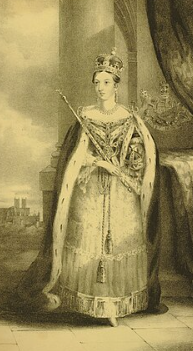
Victoria © British Mus
The far left images show the Supertunica of James II. Images 2-5 show George IV's Supertunica and its being worn by later monarchs. At the end of the line of images above you can see Victoria wearing coronation garments of state. You can see her Supertunica here
"For various reasons, some pieces have been made for specific monarchs, in particular Queen Victoria had her own robes made, probably because as a small woman she had a very different build to her predecessors, and because The Imperial Mantle was not owned by the Crown at this time."
- Matthew Storey, Chief curator at the Royal Ceremonial Dress Collection
Victoria's:
"...Supertunica was 130 centimetres (51 in) long and made on yellow warp with gold thread through it...brocaded in silk of different colours with a scroll design using roses, thistles, shamrocks and palm leaves...edged with gold lace and
gold-coloured spangles...lined in red satin. Silk decoration was attached by silver hooks either side of the centre front.
The gown opens to the front and had skirts gathered in at the centre of the back. The neck is low and rounded and the sleeves
hang to the knee."
Note
Silk Queens: Interestingly, in the 1930's the silk industry in Macclesfield had
it's own royalty. Please Click here to watch the Macclesfield was crowning
coronation of Britain's first silk queen in1933-'34.
This portrait of George III shows us another example of cloth of gold:
© Royal Collection Trust
Allan Ramsay (1713 - 1784) George III, c. 1761-2 Oil on canvas
"The king is shown in his coronation attire - the purple velvet Robe of Estate lined with ermine fur, worn over a coat and breeches that follow the lines of contemporary fashion (except for the enormous cuffs, made entirely of cloth of gold brocade. In 1761 Ramsay reported that he had 'the Royal robes set upon my figure.' It was common practise for clothing to be lent to an artist after an initial sitting to avoid the subject needing to sit for lengthy periods."
- Dressing the Georgians exhibition 2023 Royal Collection Trust
So really what other colour could the papery "fabric" of this piece be named after...? Except...! That is, for deep velvety purple of course. I knew I needed to incorporate this into my design.
1. 
2. George VI 3. Charles III 
4. © Royal Collection Trust 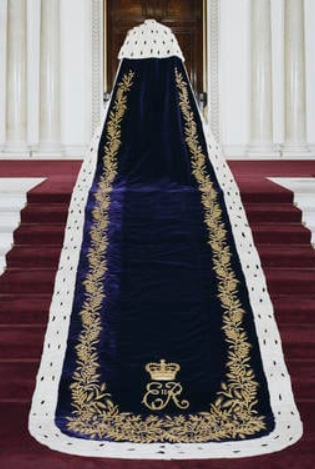
5. © Royal Collection 
6. © Royal Collection
images from right to left above show:
6. the Robe of Estate worn by "...King George V following his crowning during his Coronation at Westminster Abbey, 22 June 1911.This same item was worn by King George VI following his crowning during his Coronation at Westminster Abbey, 12 May 1937. According to a note on its historic storage trunk, an ermine lining was removed from this by Queen Elizabeth The Queen Mother in 1953 . Following the Coronation the Robes of the King and Queen and the two Princesses were displayed at the Royal School of Needlework [which was then in South Kensington, now at Hampton Court]...at the Royal Scottish Museum...then toured Australia". https://www.rct.uk/collection/search#/1/collection/75071 It was also worn by King Charles III at his coronation for the final parts of the service, the return to Buckingham Palace and the balcony appearances in 2023.
5 The Robe of Estate worn by The Queen for her Coronation at Westminster Abbey on 2 June 1953
4. The robe of estate worn by Queen Elizabeth (later Queen Elizabeth The Queen Mother) to the coronation of King George VI and Queen Elizabeth at Westminster Abbey, 12 May 1937. "Designs were being submitted to the Queen in January 1937 with the clear intention of including the emblems of the Dominions and the home nations. The cut is similar to the Robes of Estate of Queen Alexandra and Queen Mary." https://www.rct.uk/collection/75052/queen-elizabeths-robe-of-estate-coronation-robe
3. Charles III
2. Queen Elizabeth The Queen Mother and King George VI
1. George V
"This is one of five important robes worn by a monarch during the service, but unlike the robe of state it is purple, referencing Roman emperors. The imperial mantle, which had been perfectly preserved and kept in private hands since 1821, is a beautiful example of Spitalfields handloom work, which had been of Huguenot origin. The emblems of the three Kingdoms of England, Scotland and Ireland are skilfully woven into the fabric."
At Warner's, a weaver called Mrs Calver can be seen in this link weaving purple velvet for the Coronation Robes of Queen Elizabeth II in 1953 (please see p104 of the article: https://www.pasold.co.uk/download/%7BA14AC35B-4095-46E1-BBB9-F54A05D5DA92%7D/made-in-east-anglia )
Up to one hundred years on from where we started, on 22nd June 1911, 12th May 1937 and the 6th May 2023 George V, George VI and Charles III wore the imperial mantle or robe that The 'London Gazette' reported was shown to visitors on March 30th 1911 in the offices of Mr. Warner whilst it was being woven. The same paper described that, nearby in Sudbury, there were the:
"...hand looms...from which will be made the flowing robes to be worn by King George and Queen Mary when they are crowned..." The paper went on to explain that His Majesty had announced "...a good time ago that every item of the Coronation robes was to be British made, and Messrs. Warner and Sons were honoured, as on the last occasion (Edward VII's Coronation), with commands for the most important of the fabrics required...In the principal weaving room the visitors were shown the cloth of gold being woven on the loom by the firm's most capable craftsman, Mr. Thomas Wheeler. He is not pressed for time, and executes about nine or ten inches a day of the cloth. The end result in threads of gold and silver is a surface of most beautiful radiance, and almost satin like smoothness. Another feature of great interest was the brocades for Queen Mary's dresses. These attracted great attention and admiration, and are regarded as superb specimens of the silk weavers' art, and in each and every case at the direction of the Queen, English materials are being woven in English patterns. Of the Queen's dresses, there were plain satin, pink and silver, Chinese hawthorn pattern, ivory white silk, into which is woven five different shades of metals in gold and silver to produce chaste designs..."
That then was how the history of silk weaving in Britain was to be related to this piece but there was to be another beautiful, historic thread technique that needed to be integrated. Embroidery.
The Royal School of Needlework
Established in 1872 The Royal School of Needlework is based today at Hampton Court Palace and worked on nine pieces for the 2023 coronation of King Charles III: the King’s Robe of State; the Queen’s Robe of Estate; the Anointing Screen; the Stole Royal and Girdle; the Chairs of Estate and the Throne Chairs.
In fact I had see a coronation train at The Fashion and Textile Museum in an exhibition about the work of The Royal School of Needlework in 2021 but at that point in time working with the school on a piece for a collection I hadn't even conceived off yet would have been only a pipe dream.
Following discussions between Historic Royal Palaces (HRP) and the RSN that began in 2024 it was confirmed that RSN students would be working on the train of this court dress. So I began sourcing gold thread:

Fashion research
I have shown each one in another post to which it also relates but I wanted to include these images of golden yellow clothes made for those not quite of coronation status. It seems to be a fairly common colour when you start looking into the history of silk in the UK.
Kensington Palace Worthing Museum Macclesfield Silk Museum
Chertsey Museum likewise has a beautiful golden yellow gown: https://www.facebook.com/photo.php?fbid=845927604202527&set=a.215925403869420&type=3
Design
So what did I have in the end from all of this to work with? As I have mentioned I was planning a partner piece for the court Dress Symphony of Stars which I showed at The Royal Pavilion in 2022 and which had been inspired by court fashion from 1822. This new dress Cloth of Gold would be dated to approximately 1821, inspired by the date of the start of the apprenticeship of William Folliott (II) and by the work done by his son, silk designer and weaver, William Folliott (III) on the cloth of gold (and purple) garments worn for Royal Coronations from then until now. I was inspired by the imagery found in Samuel Wilson's journal, the markings of the process of weaving he showed. I had also read of several other individual Huguenot silk weavers related to Fournier Street, Spitalfields and I knew by now that silk weavers grew Auriculas on the shelves of miniature theatres in their backyards. I am detailing my auricula research in a separate post about the Auricula Border I planned to apply to this piece.
But importantly the research above also included consideration of the move that was being initiated during this period away from home working and into mills. Symphony of Stars has a paper theatre at the centre of the skirt (showing John Nash's original sketch of the design for the Music Room at The Royal Pavilion) so I planned that Cloth of Gold would also have one but this time portraying the workings (the cogs and wheels) of the looms in the mills. And I wanted to include text so I did some research into child labour in textile mills which I am also detailing in a sperate post titled - blindness, deafness, knock knees & hump backs. In my mind I could see children running around the very edge of what would be a long gold train, perhaps the same gold satin/tissue paper quilted effect achieved on the centre of the train of Symphony of Stars, only more so? That was yet to be decided. This was all enough to be going on with now I needed to do the drawing.
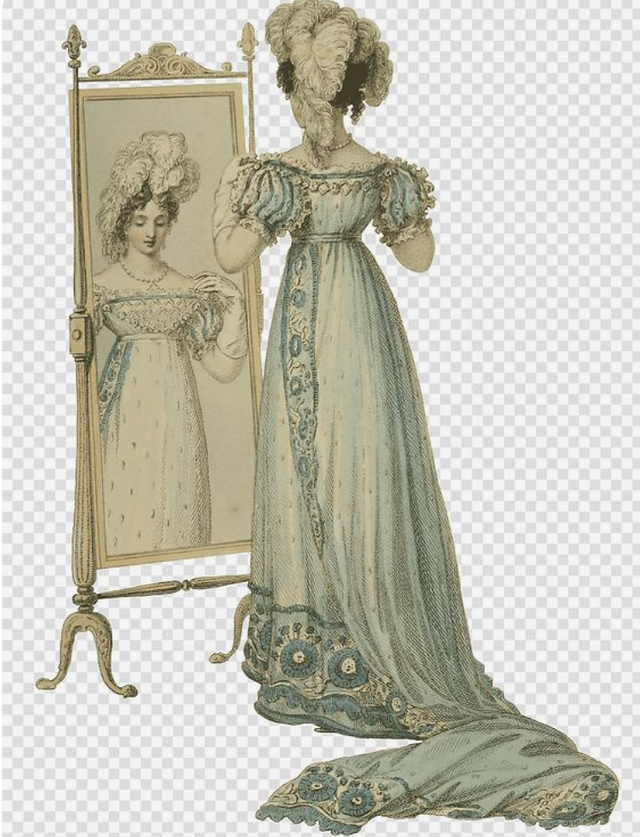
For an overview of Regency court dress style please see: https://beatriceknight.com/regency-court-dresses-unflattering/
Design
I wondered for a moment whether I going to copy the deocration on a coronation train exactly on the train of my dress? But I never copy any historic fashion exactly. I look, I develop, then I adapt and redesign. And I wasn't making a coronation outfit. I was making a court dress and train inspired by them. Next I started to wonder about the symbolism of purple and of certain purple plants like the Iris:
And then about how you create purple using plants, so I started researching purple dye plants, and it was this that got me my answer:
So I started drawing
On the floor. I still don't have a decent sized table so have to work mostly on my knees.
I would go on to draw certain parts on gold tissue and free machine embroider the edges to aid hand embroidery for the RSN students.
Then by borrowing a larger room I was able to start working up the back of the dress. Anyone who sat too close when I'm making gets covered in tissue paper confetti.
Hem
If that was to be the train, with the centre being embroidered then what of the front of the skirt of the dress. I had looked at hems with relief style decoration for the partner piece to this dress and I wanted to return to that, so popular was it during the Regency and so intriguing (to me).

I asked House of Embroidered Paper volunteer Margaret to try some paper weaving designs we had come across because I though this technique might be incorporated.
In the end I returned primarily to the auricula element of this design, employing the 3-d style ones of those we were all making. Perhaps I thought with woven leaves? That sounded doable.

Tassels
I was lucky enough during the process of researching this collection to visit Declercq's, the Passementerie studio in Paris, and to view their historic collection.
Made often mostly of wire and wood many traditional tassels had elements also made from cardboard and thread. I was in fact researching tassels for about 4 of the garments in this collection whilst I was there. Some of the gold ones above are originals from the Paris Opera House which Declerq's have repaired and copied, included here not least because of the title of this piece. I certainly wanted something that grand for the dress called Queen Anne Silver but I needed to create smaller tassels for the front and back of this dress.
It was very inspiring to see beads and flowers and shapes of every kind, everything you might imagine and more.
Mine would grow around paper forms.
and for an attached belt I looked to Historic trim
which House of Embroidered Paper volunteer Kerry reproduced
Neckline
As regards the neckline of this piece I am just going to include some of the images I looked at:
Paper theatre
As part of the decoration on this dress I wanted to reflect the mechanisms and movements of the looms used in the manufacture of silk as they would have appeared to early British mill workers. I took the images below at Whitchurch Silk Mill (set up in 1817).
One of the mill's current weaver/tacklers was able to tell me that though their working Victorian looms wouldn’t have had the cages on them that they do today. They don’t know when it was installed but the Factories Act of 1961 established a strict, "absolute duty" to fence any dangerous machinery, meaning guarding was required regardless of cost or practicality. None of the earlier photographs dating from the early twentieth century shows any caging, so this is most likely an addition after 1961.
Some of the cogs and wheels would have been as you see them in the 1820s. The pully wheels (the ones on the outside with smooth grooves in them) would have been added later and some were joined to electric motors in the mid Twentieth century whilst others would have been joined to the water wheel pully system. You can still see the workings of this inside the building today. It is no longer connected, since the introduction of an electrical power source. The wooden loom on the top floor dates to the 1830s
Then I started looking at mill water wheels and my thinking shifted thinking. The first below is from Whitchurch Silk Mill (minus its slats which were damaged by being stationary during the Covid-19 closure of the mill). The others show a model I looked at in the Science Museum, London
I was also planning mini bobbins wound with the finest Whitchurch silk thread and silk thread Shirtlace buttons which I find very wheel like in their design.

Buttons by House of Embroidered Paper volunteer Kerry
This was because I wanted to also reflect some of the machines inside that were turned by the water wheel. You can see them below being used historically and still today.
I didn't have water power to help me wind the thread onto my bobbins which themselves had been made from the inner tubes of silk thread bought from DeVeres yarns and quilled paper roundels, sprayed gold.
Necklace
The last decision was regarding a suitable necklace. Which was sorted out when I cam across this piece in The Royal Collection and the House of Embroidered Paper volunteers were able to start quilling.

Weaving Silk Stories is a new project in partnership with the independent charity Historic Royal Palaces, which is due to launch in 2027.
Paper sponsorship by Duni Global


