
1780's - research & making - Looming
- Apr 13
- 11 min read
Updated: Jul 5
A silk detail
“Technologically, the cotton industries were stagnant from the sixteenth century to the eighteenth century, whilst silk, especially in throwing machinery, was not…European silk designs were also influenced by Asian products between 1670s and 1730s, although from China rather than India. Silk continued to be important within elite fashion: Paris and London, with their large aristocratic populations, remained the leaders of trends in female and male fashion respectively…the main development within elite European fashion…the movement towards lighter and plainer silks, rather than towards different fabrics. In both countries, the main silk manufacturing centres, Lyon and Spitalfields, were well integrated into serving the tastes of this patrician market…[with] sophisticated processes of seasonal product differentiation and marketing developed by Lyonnais merchants.”
chrome-extension://efaidnbmnnnibpcajpcglclefindmkaj/https://eprints.bbk.ac.uk/id/eprint/40058/1/Farrell%20thesis%20silk%202013%20v.2.pdf
A Royal detail
George III - ruled between 1760 and 1820. He...
"...was the first truly British monarch of the Hanoverian kings. Ruling Britain was his first priority and he never visited his family's home in Hanover. He was a well-intentioned and cultured family man. Sadly, his personal and political life was dogged by recurring bouts of severe mental and physical illness, and he was declared unfit to rule in 1811, handing the throne to his son, the Prince Regent, when his health failed. His illness baffled his doctors and has fascinated modern minds)
Lines
I needed to look at not only the makers but also the machinery in my research for the Weaving Silk Stories collection. There is other equipment involved in the art of weaving of course but of foremost import is the loom.
"Loom frames can be roughly divided by the orientation of the warp threads, into horizontal looms and vertical looms. There are many finer divisions. The earliest evidence of a horizontal loom is found on a pottery dish in ancient Egypt, dated to 4400 BC. It was a frame loom, equipped with treadles to lift the warp threads, leaving the weaver's hands free to pass and beat the weft thread"
I touch on warp weighted looms, Inkle looms and tablet looms in other posts. The history of each is long. You will also see further links to illustrations of the horizontal hand looms of the Huguenot weavers in Spitalfields (in use at the time of the style of the polonaise dress referred to below), in other related posts. Tapestry looms and Treadle looms might be subjects for another project

An 18th century French drawloom for the weaving of firgured velvet
You can see other photos of the tappet and dobby looms used at Whitchurch Silk Mill by clicking here But I want, in the images below, to draw your eye and attention to a particular aspect of the aesthetic of weaving.


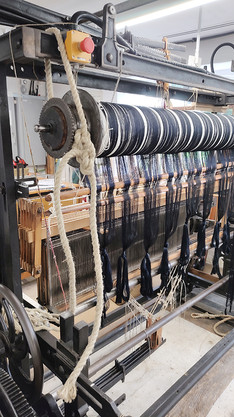
Can you see what I immediately loved the look of? Yes those lines!
And the ends left hanging in beautiful loose knots during the warping process.
We will return to those but first back to the lines!
Vertical and horizontal. They are formed of thread, lingoes (the long lead weights used to keep the tension on lifting) and heddles (used to separate the warp threads for the passage of the weft).



As well as reeds and harnesses.


All these lines seem to communicate, back and forth, forming the 3-dimensionality of the machine, which is otherwise made up from the lines of the wooden bars of the skeleton of the loom.


By the manner in which it has been drawn this image from the wall at The Huguenot Museum, Rochester, seems to sum up the sketchy verticality and horizontality of the lined nature of the craft of weaving. It was a look I was determined to reflect in one particular piece. This one...
Looming, the title of this post, is not a word associated with weaving looms. Instead, as an adjective or a verb, it means in fact: "- (of an event) seemingly about to happen and regarded as ominous or worrying "the looming threat of social unrest" - appearing as a vague or shadowy form, especially one that is large or threatening. "he almost expected to see Jason's looming figure suddenly appear"
mid 16th century: probably from Low German or Dutch; compare with East Frisian lōmen ‘move slowly’, Middle High German lüemen ‘be weary’." - https://languages.oup.com/google-dictionary-en/
But I think it is a wholly appropriate term in relation to: the age of the looms at Whitchurch Silk Mill and, more surely still, the ghostly sense it's possible to glean from standing in between the looms at Paradise Mill, Macclesfield. A sense, that is, of the hovering presence of those who once worked there. The heritage of such looms indeed looms out at you, the weight of the work done, evident from the wear they have suffered.
Stripes
Another reason I wanted to consider straight parallel lines in this piece was to reflect the weaving of stripes. These wonderful examples come from the recent order books of Whitchurch Silk Mill:

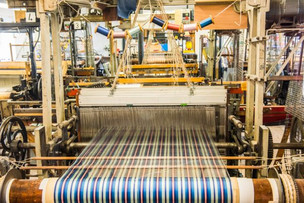


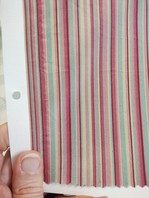


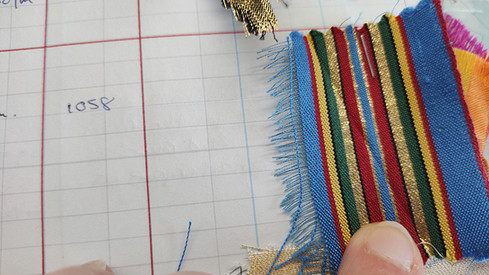


Because they don't have Jacquard looms Whitchurch Silk Mill can't weave patterns. So they have always produced either silken sheets of solid colour or silken sheets of coloured stripes.
But even in Macclesfield (known as the silk town), in the 20th century, the jazz band was dressed in silk stripes woven at Paradise mill. Indeed the town had it's own type of stripe. The Macclesfield stripe!


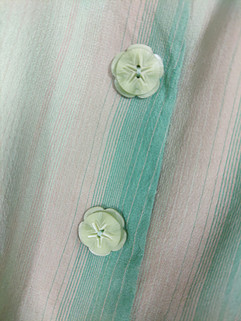
On a visit I made to see pieces in the archives of Macclesfield Silk Museum I saw some Macc stripe dresses of the sort that were mass produced in the 20th century and worn even by the "best dressed mill workers", themselves, those who worked at Paradise Mill.


Note: those lovely buttons!











Another reason for weaving in stripes historically was the making of silk ribbons. In literature from the time, it seems as if that there wasn't a woman alive in the 1700's and 1800's who didn't crave and enjoy (if they could afford them) fine silk ribbons. Ribbons were also used to pull up the puffs of a Robe à la Polonaise the style of the dress I intended Looming to be.
Whilst it is still practised in the manner you can see here (whole sheets woven on a broadloom that are then cut into ribbons, meaning that each ribbon doesn't have a woven selvedge) silk ribbon making is now considered in fact a critically endangered craft in the UK meaning there are very few practitioners left and it is expected to die out within the next ten years.
Silk weaving itself is recognised as an endangered heritage craft in the UK.
Despite listing so many other types of loom it is the Jacquard loom, I want us to settle our attention on, in respect of this piece, the Jacquard loom
Here on Humphries Weaving website you can read about the history of the Jacquard loom and about Monsieur Jacquard himself. His Lyonnais heritage links him nicely to the Huguenot silk weavers I spoke of here
Jacquard Handloom Weaving is also now on the endangered craft list. Macclesfield Silk Museum is trying to restore as many of its looms back to working order as possible. They have a collection of 26 Jacquard handlooms – the largest collection of Jacquard handlooms in Europe still in their original positions. It’s a designated (protected) collection, which means that the looms cannot be removed from their positions. They are hoping to train young weavers in this process so that its not lost forever, and have had several weavers in residents in the mill.
Damask
Damask weaving is likewise considered today as being critically endangered in the UK. To see an example of 18th century damask please click:
Damask designs contrast starkly with stripes and were made much easier after the invention of the Jacquard mechanism. I knew I would integrate pattern with stripes in this piece. Damask seemed highly appropriate. It has moved through stages of popularity, evolution, mechanisation and unfashionable decline as surely as the silk industry in Britain itself. But once it decorated and dominated Royal Palaces. This one (below) is the Hampton Court damask.

© Historic Royal Palaces
In the 17th century the classic for furnishing was damasco della palma.
"In France, in 1801, Joseph-Marie Jacquard perfected a semi-automatic mechanism for silk damask weaving, replacing the highly labour-intensive draw loom. It was soon adapted for linen damask weaving, reaching Britain by the 1820s."
Please click here to see Damask weaving in action.
The Jacquard loom differs from one that isn't in one primary regard, the mechanism that sits on top...

Model of a Jacquard loom (scale 1:2) 1867
Science Museum Group Collection
© The Board of Trustees of the Science Museum
...through which punched cards are fed.


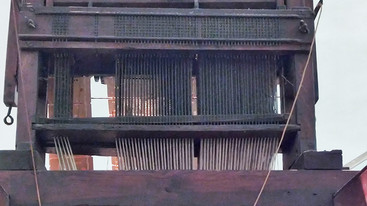


Images of a Jacquard loom at the Science Museum, London.
In my mind now I could see the mechanism, the cards and the vertical as well as (as you can see below) angled lines. All of which I would be looking to reflect in this dress







The Polonaise
From early on I knew the style of dress I wanted Looming to be.


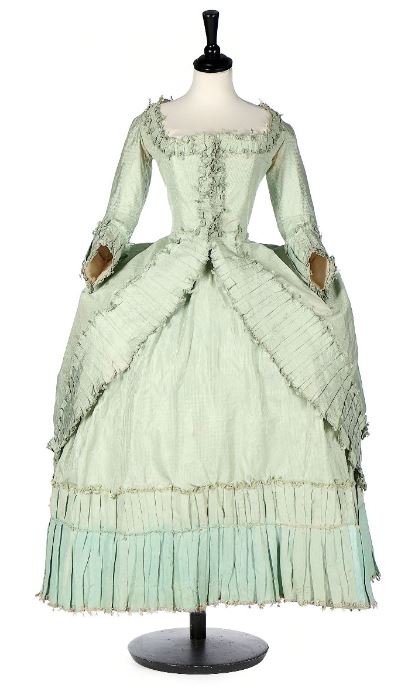
a peppermint-green silk 'Circassienne' robe, French, circa 1780
© Kerry Taylor auctions
"By the mid-18th century, the mantua had evolved into a formal version principally worn for court dress. The draping of the overskirt became increasingly stylized, with the back panel of the train almost entirely concealed. Known as the sack, sack-back, Robe à la Française, or French gown, this garment was supported by panniers which expanded in width in the 1740s and 1750s, and fronted by a decorative stomacher. Underskirts were displayed at the front, with two substantial box pleats to the back allowing fabric to trail loosely from the neck to the floor. This style of mantua was most typically worn as formal attire between the 1750s and 1770s..."
As part of the evolution of this dress shape:
"The three gathered back sections of the skirt and fitted bodice of the 1770s incarnation of the mantua, known as the polonaise gown or Robe à la Polonaise, were distinct to this style, with the puffed skirt achieved through cording or ribbons."
"A robe à la Circassienne was a variation of the robe à la Polonaise only it was adorned with so-called Oriental tassels or fur. Another difference was that the robe à la Circassienne had small "over-sleeves" which was inspired by the fashions of the Middle East. These over-sleeves were normally shaped like a funnel and overlapped tight-fitting long - or three-quarter length - sleeves. The long sleeves would often end in cuffs; the skirt would often be fitted with frills
The style seems to have become popular in the 1770's and would remain in style till the revolution. In France the style would continue to be puffed up whereas the English version would eventually become less full in the back. The bodice of this type of robe was often very low."
As my research progressed I noted mention of tassels and frills and long sleeves with cuffs,

Robe à la Circassienne Garnie à la Chartres: la Coëffure de meme, Avec le Tableau des Evenements from https://commons.wikimedia.org/wiki/File:Robe_%C3%A0_la_Circassienne_Garnie_%C3%A0_la_Chartres-_la_Co%C3%ABffure_de_meme,_Avec_le_Tableau_des_Evenements_MET_DP809857.jpg
For me there is something rather risqué about this style in general. Not least the neckline. A small mantua it may be but it has more puffs, frills and bare ankles than any of the earlier versions. The skirt gives the impression of theatre curtains, designed to be pulled apart!
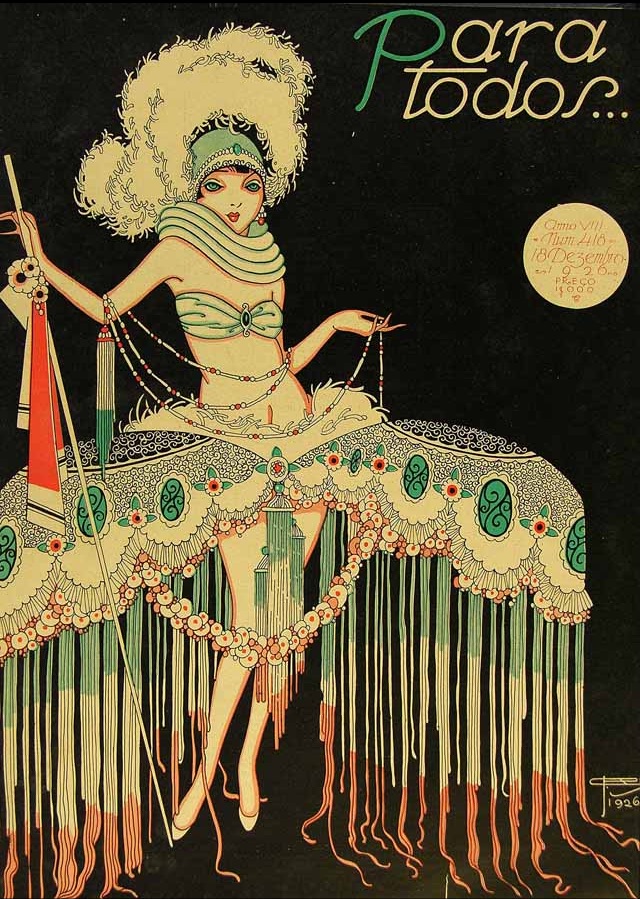
A century and a half later this idea and the notion of what might be beneath a mantua was being played upon by graphic designers like Brazilian Art Deco graphic design artist J. Carlos (José Carlos de Brito e Cunha) in an image that likewise incorporates the idea of hanging vertical threads such as I plan to incorporate.
Cover for the magazine Para Todos, produced between 1926-1930
The long fringing looks to me like the lengths of thread left hanging from a loom (as shown in the images at the start of this post), that is, during its set up, the lengths that might then be temporarily knotted
As part of my research I visited Worthing Museum to look at the construction of a polonaise. Inside itself the dress is indeed all ribbons, gathers and what look like button holes
You can see more details of my visit here
This is an interesting site for consideration of the construction: https://libertabooks.com/costume/historical-costume-1780s-polonaise-gown/


The Polonaise style would see itself reinvented 100 years later in the 1880's and 1890's
To see how the back should lift up it was interesting to look at a dress with the fabric hanging flat
and then to compare how different versions were gathered differently. As with many features of historical fashion it seemed at times, whilst I was looking, that there might be almost as many variations of ways in which the sides of the skirt could be gathered as their were dressmakers to imagine them.

Robe a la polonaise, Lot 355 Kerry Taylor auctions (please click on the image to be taken to the source)
Pannier
With garments such as these you have to consider underwear. This is where we'd come from in 1760's
And these were some of my sources when considering construction
Trim
Please click on the images below to see examples of the polonaise both © The Met Museum Collection.


Of all the dresses I have looked at this is arguable one of my favourites: https://collections.vam.ac.uk/item/O15539/gown-unknown/
"Aileen Ribeiro describes the polonaise as "cut in four parts, two at the front and two at the back," with the bodice closed at the top center front and sloping away at the sides, leaving a triangular gap that was filled by a false waistcoat. Sleeves could be three-quarter length or long, and various styles such as the Irish, Italian and French polonaise were described by contemporaries. A variation on the robe à la polonaise was the robe à la circassienne, cut the same but trimmed with "oriental" tassels or fur."
But it was when I came across the papery folds and passementerie on this Robe à la Circassienne that my mind really started whirring

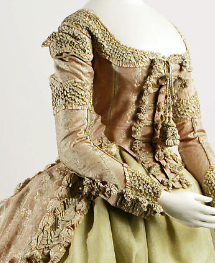


© The Met Museum
French Robe à la polonaise, ca. 1778-1780
The pattern of the trim around the neckline and on the shoulders and the sleeves reminded me of the shapes in this silk print from the 20th century created by silk weaver Lesley Winnel for a piece of weaving I had seen left remaining on a Jacquard loom at Paradise Mill, Macclesfield. It was spookily seemingly abandoned unfinished. The mill closed around and halfway through the act of weaving.


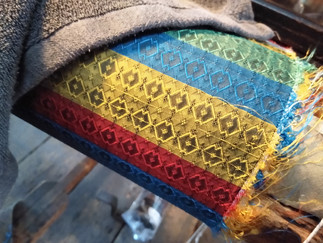


You can read about Lesley's life in this post about the mill.
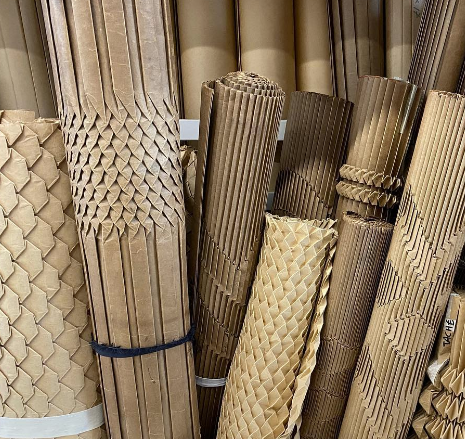
I had seen similar patterns also, created using paper and card pleating moulds:
"ready to pleat the most luxurious Chanel ready to wear and haute couture materials from filmy silk chiffon to leather...Gerard Lognon atelier; one of the group of Chanel metier d’art now housed together at 19M - in a state of the art modern building in north Paris - that accommodates 600 skilled workers."

So how to bring all of this together?
Design

Making
I need some paper pleated more perfectly than I could personally manage so I got in touch with Ciment Pleating in London


The buttons on this dress would be Shirtlace I decided. Through the making of this collection the volunteer team behind The House of Embroidered Paper and I were experimenting with, learning and adapting, various historic thread button designs. which you can read more about here


Gina B Silkworks is an amazing modern day resource in this regard, please click here
Of course whilst historically many thread buttons were made over metal rings we had to find another way, cutting slivers of cardboard inn tubes and cutting circles out of card that were then stuck together (both options coated in wood glue) proved the way to go.
I wanted to reflect the risque nature of fashion, which I saw in this dress style, in my colour choices. So I decided to combine red and pink. And where I could indeed scarlet and shocking pink. Long considered a fashion faux pas that rule appeared perfectly placed to be broken in this regard.
This meant scarlet and deep red nail varnish came into play for coating the paper beads I intended to hang from the dress


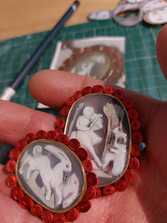
And when I decided I wanted to add a necklace it had to be one with rubies. Looking for a Royal piece as inspiration I settled on this cameo from The Royal Collection:

There are separate earrings and a brooch to match:


Weaving Silk Stories is a new project in partnership with the independent charity Historic Royal Palaces, which is due to launch in 2027.
Paper sponsorship by Duni Global


