
Weaving Silk Stories - research & making - the auricula border
"In horticultural lore, auriculas have always been associated with Spitalfields..."
"The Huguenots set up their own society in 1703, having an inclination towards floriculture and gardening."

© Historic Royal Palaces 
© Historic Royal Palaces
Botanical drawings © Historic Royal Palaces
"Originating from the alpine meadows of Northern Europe...The present day Primula auriculas are a hybrid of a wild Primula auricula and Primula hirsuta"
"...first recorded in England in the Elizabethan period as a pastime of the elite but it was in the eighteenth and nineteenth centuries that they became a widespread passion amongst horticulturalists of all classes. In 1795, John Thelwall, son of a Spitalfields silk mercer wrote, “I remember the time myself when a man who was a tolerable workman in the fields had generally beside the apartment in which he carried on his vocation, a small summer house and a narrow slip of a garden at the outskirts of the town where he spent his Monday either in flying his pigeons or raising his tulips.” Auriculas were included alongside tulips among those prized species known as the “Floristry Flowers,” plants renowned for their status, which were grown for competition by flower fanciers at “Florists’ Feasts,” the precursors of the modern flower show. These events were recorded as taking place in Spitalfields with prizes such as a copper kettle or a ladle and, after the day’s judging, the plants were all placed upon a long table where the contests sat to enjoy a meal together known as “a shilling ordinary."
They are mentioned in Gerard's herbal of 1597 but as you can see here their origins in Britain are contested to this day:
"Tradition has it that the auricula was introduced into England by Flemish weavers fleeing religious persecution on the Continent. A more likely explanation is that the plants arrived by interchange between leading Continental and English gardeners, as happened with many other plants."
Still...
"In the nineteenth century, Henry Mayhew wrote of the weavers of Spitalfields that “their love of flowers to this day is a strongly marked characteristic of the class.” And in 1840, Edward Church who lived in Spital Square recorded that:“the weavers were almost the only botanists of their day in the metropolis.” It was this enthusiasm that maintained a regular flower market in Bethnal Green which evolved into the Columbia Rd Flower Market of our day."

Truly a flower treated with care and reverence, here is an image of the auricula theatre at Hampton Court where they are known to have been grown during periods when the palace was a royal residence.
What this proves is that they were loved by Royalty and working people alike, all of whom treated them with reverence and that these plants were grown to be displayed. After all, what other plant have had miniature theatres, in backyards and palace grounds, built for them (sometimes with curtains)!
"Known variously in the past as ricklers, painted ladies and bears’ ears, auriculas come in different classes, show auriculas, alpines, doubles, stripes and borders – each class containing a vast diversity of variants...the best starting point to commence your relationship with this fascinating plant is to feast your eyes upon the dizzying collective spectacle of star performers gathered in an auricula theatre. As Sacheverell Sitwell once wrote: “The perfection of a stage auricula is that of the most exquisite Meissen porcelain or of the most lovely silk stuffs of Isfahan and yet it is a living growing thing.”
I am planning a display of a row of auriculas around the edge of the train of the dress titled Cloth of Gold and though the Royal family had moved on from Hampton Court by the time of the date of this dress, so we can't be sure that auriculas were being grown there during the reign of George IV, they have made a return as part of Historic Royal Palaces National Plant collection.
But auricula growing continued as a passion for weavers in particular well beyond that point and well beyond London. They were:
"...very popular in Northern England, where they were called “cowslips” or “bear’s ears.” Weavers in the region, especially those of Flemish ancestry, embraced auricula cultivation from the 1600s through the 1900s. No matter where auriculas were originally from, the Victorians embraced these lovely blossoms and included them in their floral lexicon.
"They were popular with florists, which then described the people growing plants to specific criteria not flower sellers, in the north of the country and were collected by both rich and working men who used their free time to cultivate & breed new varieties. With travel and recreational activities limited, many people grew plants competitively (not just auriculas but dahlias, carnations and many more), always striving to grow the very best specimens. Annual auricula shows were hosted in the local pubs and the plants were judged to very specific, very exacting standards, many of which are still used today. The owner of the best auricula would take home a coveted ‘copper kettle’ that adorned the front of the pub on show day."
Note: Around the end of the eighteenth and the beginning of the nineteenth
century a large number of what were called Florists' Societies were formed.
A Florist was defined as a gardener who grew a limited range of flowers
to a strictly defined set of rules or standards.
This is the auricula theatre at Sissinghurst Gardens, Kent

I hoped to spot auriculas in historic silk designs. It seemed logical to me that they might be there and they may be but I didn't really find them. This was as close as I could get:

1730 ©V&A 

1742 ©V&A 
1743 ©V&A
From left to right by Anna Maria Garthwaite 1730, 1742, 1743. They can be seen in Silk Designs from the Eighteenth Century from the Victoria and Albert Museum, London Edited with an introduction by Clare Browne
Then I found these woven into the silk of a mantua I saw on display at Kensington Palace as part of the exhibition Court to Couture. This is a Spitalfields silk.
A court gown dated 1750-1753 © Royal Ceremonial Dress Collection
I felt I got a little bit closer also when I looked at the 19th and 20th century design books held at Macclesfield Silk Museum:


© Macclesfield Silk Museum 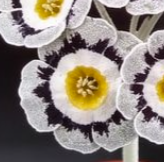

© Macclesfield Silk Museum 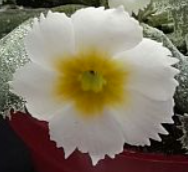

© Macclesfield Silk Museum 

© Macclesfield Silk Museum 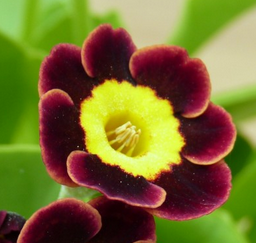

© Macclesfield Silk Museum
They are very varied. You can learn more about the different varieties here: https://horticulture.co.uk/auricula/varieties/


Design:
From the Macclesfield collection I especially liked this design which seems like it might take it's inspiration from the way in which auricula flowers grow, all clustered around the top of one stem

© Macclesfield Silk Museum 
© Historic Royal Palaces
This then was where to become the border design for the train of the gown called Cloth of Gold.

Making
I wasn't stopping at a single representation. As you can see from that design the outline auricula shape has the individual flowers within it. Those would be made using quilling.
But I wanted some that would sit even more three-dimensionally so next I developed a design using a Yorkshire silk thread button making technique and mizuhiki rolled rice paper cord.
And they too with have their own auricula shaped border. I worked on some of these with volunteers from Whitchurch Silk Mill
Please come back to see the completed effect on the dress titled Cloth of Gold in 2027
Weaving Silk Stories is a new project in partnership with the independent charity Historic Royal Palaces, which is due to launch in 2027.
Paper sponsorship by Duni Global


