
1899 - research & making - Poverty mapped
- 13 hours ago
- 10 min read
A detail from the history of silk in Britain silk
Silk’s popularity and success in England had owed a lot to protectionist policies and a ban on imported silk goods. When this was removed in 1860 - when Britain signed the Cobden Treaty with France - .many British silk weavers suffered. The rise of lower prices for imported silk meant many went out of business. But silk remained popular well into the next century.
A Royal detail
Queen Victoria - was Queen of the United Kingdom of Great Britain and Ireland from 1837 until her death in 1901. Her reign was a period of industrial, political, scientific, and military change within the United Kingdom. In 1876, the British Parliament voted to grant her the additional title of Empress of India. Alexandra of Denmark (Alexandra Caroline Marie Charlotte Louise Julia; 1 December 1844 – 20 November 1925) was Queen of the United Kingdom and the British Dominions, and Empress of India, from 22 January 1901 to 6 May 1910 as the wife of King Edward VII.
Research
After having looked at dolmans (and bustles) in my post titled Cocoons I need us now to traverse the 1880's and look forward to the very end of the 19th century. That is, in relation to silk and outer wear. I want to start with a overview of the changing silhouette and at this point in history the designer of note is British. Charles Frederick Worth was born in Lincolnshire in 1825. He founded the House of Worth in 1858 and it dominated Parisian fashion at the end of the nineteenth century/start of the twentieth.
I begin the series of images below with a tea gown by The House of Worth from the 1880's and here you can see a dolman from the same decade, to remind you where he was coming from in terms of the shapes of womenswear: https://artsandculture.google.com/asset/dolman-worth-charles-frederick/QwFj9MsaqNEhKw?hl=en But beyond that, below in date order from left to right, the next 5 coats, each by Worth, date from 1890 to 1905/6. The silhouette of the dress is different, the back flatter, therefore heavier floor length coats have become possible. I have included the last two images below however, to show that the dolman didn't vanish.
Please click on each image to be taken to the relevant page on the Met Museum website


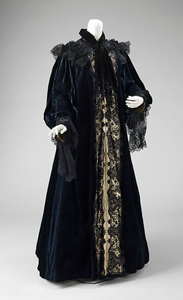


© The Met Museum
I chose the particular tea dress shown above because when I first saw it I thought I was looking through an open, lightweight, cotton, floor length, coat, over a button through dress. It reminded me of a cotton pelisse I had looked at, at Chertsey Museum, as part of my research for The Regency Wardrobe collection. That pelisse had inspired the piece called Delicate.
Of course this Worth dress is in fact a single garment, just a dress, but I knew I wanted to recreate a particular historical map that revealed more that just geography (we will come to that) and I was already imagining it on a floor length skirt, so now I started to wonder about showing it half revealed, half concealed by a floor length coat.
Then I came across this coat, which is referred to as a dress and I was sold.

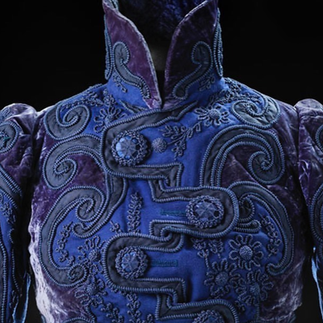


"This striking going-away dress is a triumph of late Victorian ornamentation and embellishment. It was worn by a wealthy bride with a flair for the romantic and the dramatic. After saying her vows in her grandmother's wedding dress from 1839, Elizabeth Holmes-Kerr said her farewells to her family & friends in this blue wool and purple silk velvet number. The skirt and jacket were made by a couturier who also had a flair for the dramatic. Madame Hayward was a London based dressmaker who regularly made gowns for court presentations, but also designed and made the ladies costumes for numerous West End & Broadway productions. She particularly specialised in light comedies that were vehicles for showcasing the newest fashions.
Going Away Dress of wool & silk worn by Elizabeth Holms-Kerr after her 1899 wedding to John Deans Hope.
Made by Madame Hayward, 64 New Bond Street, London
© Glasgow Museums, E.1988.104.2"
For the original source please click: https://collections.glasgowmuseums.com/mwebcgi/mweb?request=record;id=458713;type=101#
And for other images please see: https://collections.glasgowmuseums.com/mwebimages/Screen/PhotoLib_Batch_0087/E.1988.104.2_06_S.jpg
And on this page you can actually see Elizabeth Holms-Kerr wearing her going away outfit: https://ca.pinterest.com/pin/37928821849334486/







Clearly this was the garment I would primarily be focusing on.
In the archives at Macclesfield Silk Museum I found this silk design. I could see links with the trim on the coat above and knew I could integrate the two to come up with a third design (my own).

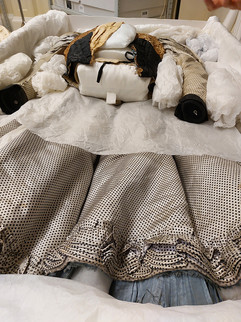
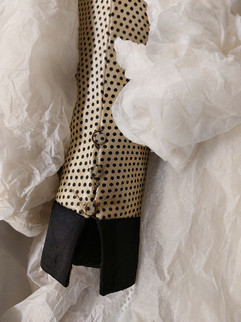
In the Royal Ceremonial dress collection I then saw this dress, which belonged to Queen Alexandra during the same era as the coat/dress above. It is too delicate now to come out of its box but you can see the whole dress here Still the curves in the design of the lace upon it and the relief effect both spoke of the effect I was now looking to achieve for my surface decoration. And of course the shoulders were a similar shape so that would be a feature of my piece.





Story
So I knew I was aiming to design a garment inspired by the end of the 1890's. I had Queen Alexandra in mind but I was interested to see if I could find a story of a commoner who was involved in the manufacture of silk at that time. Then, through Macclesfield Silk Museum, I came across:
John Thomas Winnell (b. 1887):
John was a silk weighter. In 1899 he was just 12 years of age but walking daily 2 or 3 miles up Richmond Hill, across the Hollins to work at a mill in Langley for 6am. He would finish at midday, go to school in the afternoon at Langley, walk all the way back home and help his family in the garret by winding pins.
Those were the days of child labour. In 1833 the Government had passed a Factory Act to improve conditions for children working in factories where young children were working very long hours in conditions that were often terrible. The basic 1833 act dictated at least that: there should be no child workers under 9; employers must have an age certificate for their child workers; children 9-13 should work no more than nine hours a day; children of 13-18 years should work no more than 12 hours a day; children were not to work at night; two hours of schooling should be provided each day for children. In 1844 children ages 8-13 years old could work only six half-hours a day with reduced hours for women and no night work.
In 1847 Women and children under 18 years of age could not work more than ten hours a day. In 1901 in all industries the minimum age was raised to 12 years but John hadn't benefited from that. The fact that he received schooling at the time he did makes it sound like he was fortunate, the rest is hard to imagine.
I am writing more about the hardships of mill working please see my post titled - blindness, deafness, knock knees & hump backs
John Thomas Winnell would go on (in the 1920s and 1930s) to work at Arnold’s dyeworks on London Road, Macclesfield, before becoming a handloom weaver at Arnold’s Chapel Street garret, where his brother, Henry, also worked. He married Elsie Winnell (nee Wall) and we will return to the history of their eldest son Leslie and his involvement in the silk industry in Macclesfield in the design section of this post. But first, to find out how John and Leslie ended up in Macclesfield we need to go back to the time of John's grandfather, who was also called Henry Winnell, and his older brother, George. They:
"...were the first Winnells to come to Macclesfield, travelling from Sheffield by foot in order to work in the silk trade, arriving in the 1830s. George and Henry became silk handloom weavers while their daughters and Henry’s wife became silk piecers, working at home in their garrets. Handloom weavers were paid significantly more than other silk workers and those working in garrets also had a greater degree of freedom in terms of working hours than those working in a mill setting. However, the work was also much more infrequent which meant that times could be hard if high quality silks fell out of fashion. One garret handloom weaver when interviewed around 1850 said that he was usually out of work for about three months a year. To begin with, Henry lived on Cross Street which was then classed as Sutton but by 1861 the family had moved to 32 North Street. In 1880, one of Henry’s sons, Samuel, emigrated to Paterson, New Jersey. At the time many Macclesfield silk workers were moving to Paterson due to the slump in the British Silk trade. This happened because of the Cobden-Chevalier treaty of 1860, which was a free trade agreement with France. France bred their own silkworms so did not need to rely on importing raw silk from India or China. Britain had never managed to cultivate silkworms and so their silk was much more expensive to produce than French silk. After the treaty, Britain could not compete on price and the entire industry suffered a blow from which it never fully recovered. Paterson was an attractive alternative for Macclesfield people at the time. The silk industry had been established there by a fellow Maxonian, John Ryle, who moved to Paterson in 1839. Following the American civil war (1861-5), there were high tariffs on European silk coming into America. Therefore, just at the time that free trade had effectively killed the British industry, the American industry experienced a boom period. By 1897, 15,000 people from Macclesfield had relocated to Paterson. Another of Henry’s sons, also called Henry, lived at 10 West Street, Sutton (which later became White Street) in 1881 and 28 North Street in 1891. This would have also been a garret house which involved most of the family, with the men weaving and women and girls piecing." © Macclesfield Museum
Mapping the East End
The East End of London has been variously mapped in all its complexity by Ogilby & Morgan, for example, in 1673 by Joel Gascoyne in1703 and John Strype in 1720 who described London as consisting of four parts: "...the City of London, Westminster, Southwark, and "That Part beyond the Tower" "- https://en.wikipedia.org/wiki/East_End_of_London
In the late 1890's however there came Mr Charles Booth whose maps and accompanying ledgers mapped not only the outlines of streets and buildings but something ore usually hidden, the social structure of the time.
Mr Charles Booth (1840-1916)
Between 1886 and 1903 Charles Booth conducted an inquiry into the Life and Labour of the People in London. It was one of several surveys of working class life carried out in the 19th century but:
"it is the only survey for which the original notes and data have survived and therefore provides a unique insight into the development of the philosophy and methodology of social investigation in the United Kingdom. Four editions of the survey were published: Life and Labour of the People (London: 1889)...Labour and Life of the People (London: 1889-1891)...Life and Labour of the People in London (London: 1892-1897)...Life and Labour of the People in London (London: Macmillan, 1902-1903)...However, in the published volumes, Booth only included information that could be quantified and which would not identify or embarrass any individual interviewee. For these reasons much of the vivid detail can only be found in the original survey notebooks."
The maps he created are amazingly well digitized by the LSE (placed over a map of London today for comparison) which you can view here. You can see on it that every building/house is marked using a colour code, these represent different categories of relative wealth or poverty.
I honed in on the Spitalfields area:

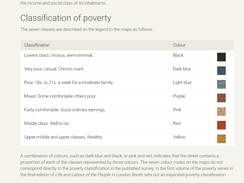


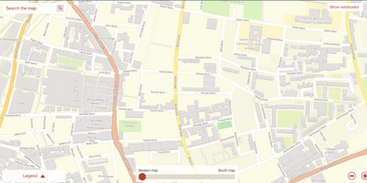
I was interested to see how the wealth and poverty of this area at that time might reflect the changes that had been caused by the loss of silk production that had happened in that area over that and preceding centuries. I liked the colour coding particularly, as a quick visual reference and had been hoping to embroider on the front of the skirt of this piece, using the same colours, in silk thread.
"...a slump in the trade partly caused by smuggling and the removal of the import duties on foreign silk in... [a]...French Treaty in 1860...pushed... [the]...Spitalfields silk weaving industry into a terminal decline. The disastrous event took away the jobs of more than 30.000 silk workers. Life for them was... [more] ...impoverished than ever. Beside the lack of persistent and determined tactics, the abandon of industrial technology, which lasted fifty years, also plays an important part in the fall of Spitalfields’ silk industry. Spitalfieds’ silk weavers, were once called the “London’s Luddites” for their long-term fight against mechanisation. It was undeniable that the invention of ‘Jacquard’ machine had led to the replacement of many male weavers. Though, the refusal of... [the] ...machine...also guaranteed...failure in competition with other high-flying silk industry in Yorkshire or Lancashire at that time.
Sir Henry Tate (1819 - 1899):
The final figure I had in mind from this time was Sir Henry Tate. He had been linked to my research into the Medieval paper maker and Mercer John Tate, please see this post to read about John.
Sir Henry Tate was an English sugar merchant turned philanthropist. Though he is noted for establishing the Tate Gallery in London he gave, during his lifetime, significant sums to charities and organisations in respect of health care and learning. This was the sort of help needed in a changing London.
I would go on to spend some very interesting hours copying the Spitalfields area of Booth's map, allowing for close examination and the discovery of certain features lost to us today: https://en.wikipedia.org/wiki/London_and_Blackwall_Railway
Making & Finished piece
I am a lover of teal, sometimes called Peacock it seems in terms of interior design. I don't make direct copies of historical garments so I wasn't going to directly match the colour of the coat/dress above but I had fallen hard for this colour silk thread and I had paper to match. So I started making cord. I have two wooden peg boards designed to be used to make short lengths of cord but for various pieces I had begun needing long lengths. In my small flat I found the longest length I could make involved trapping one end of the cording board under the weight of microwave and walking with my bobbin of silk thread across my kitchen, the adoing space and into the bathroom where I could attach the other end to the window latch. If you repeat this a few times (up to 50 for a cord thickness of 100 strands) you can then release one end and start twisting. All the cord on all the pieces in every collection are made by hand.


Here you can see me tracing the map onto tissue paper but it wasn't to end up on the front of the piece as planned.

Weaving Silk Stories is a new project in partnership with the independent charity Historic Royal Palaces, which is due to launch in 2027.
Paper sponsorship by Duni Global


