
1860's - research & making - Stitches in Air
A detail from the history of silk in Britain silk
"Parliament was collecting the report of Dr Kay “on the subject of distress in Spitalfields”. The area and the silk industry became synonymous with low wages and poverty. When Mayhew interviewed people in Spitalfields in 1849 he found a weaver making a “drab velvet for coat collars” at 3s 6d a yard, twenty five years previously the price had been 6s a yard. The healthy part of the trade was in making plain silks for umbrella manufacturers. It was in the North West and Midlands that factory production and mechanization of silk weaving was developed. The machinery suppliers Devoge & Co. sold the new jacquard looms to Manchester, Macclesfield, Leek, Coventry and Nottingham, but not to London. Families from Spitalfields who did flourish in the silk industry later in the nineteenth century, such as the Warners and the Courtaulds, relocated to Essex...Those working in the silk industry had lobbied for new sources of raw silk and offered advice and support. This consultancy role fostered on all the schemes the idea that producing quality silk was important. London was...the source of finance...either via the Treasury or the East India Company...projects used global rather than simply colonial knowledge and technology. Within India, Calcutta acted as a hub for bringing in worms from East Asia and sending materials on to Madras...Overall changes in the geography of raw silk production did not always work in London’s favour, despite growing British power in this period. In contrast to the period after 1850, regions that produced raw or thrown silk did not become dependent upon manufacturing in Britain. Indeed, in the Ottoman Empire and in Bengal there is good evidence that British traders were excluded from the best quality supplies of raw silk. In contrast to a picture of a world economy shifting towards the North Atlantic or a British empire consolidating around India, in raw and thrown silk markets the Mediterranean remained the leading centre."
chrome-extension://efaidnbmnnnibpcajpcglclefindmkaj/https://eprints.bbk.ac.uk/id/eprint/40058/1/Farrell%20thesis%20silk%202013%20v.2.pdf
A Royal detail
Victoria was Queen of the United Kingdom of Great Britain and Ireland from 1837 until her death in 1901. Her reign of 63 years and 216 days was longer than any of her predecessors. It was a period of industrial, political, scientific, and military change within the United Kingdom, and was marked by a great expansion of the British Empire. In 1876, the British Parliament voted to grant her the additional title of Empress of India.
Research
As part of the Weaving Silk Stories collection this piece is to be inspired directly by silk moths. That is, not only the pure white, hard working, variety Bombyx Mori but also their more luxuriant, relaxed, large-winged, giant cousins Saturniidae, a family that includes the Cecropia moth, the Luna moth, the Atlas moth and the Imperial moth. To read more about them please visit the post I wrote detailing a visit I made to the Natural History Museum by clicking here
Insect dresses
There was in fact an Indian tradition of including insect parts into the decoration of Victorian fashion. The image below shows a detail of a dress decorated with the wings of jewel beetles (buprestidae)
"...they were traditionally used to embellish textiles in South America and South and Southeast Asia. Emerald-green beetle-wing decoration became a symbol of high status in India during the Mughal period (1526-1756). Western traders in India then introduced these textiles to Europe in the late eighteenth and early nineteenth centuries. British newspapers report on several women wearing dresses decorated with beetle wings at court during the late 1820s and early 1830s. By the 1860s beetle wings were being imported to Britain in volumes of 25,000 per consignment, to be applied to textiles in imitation of the Indian technique. The wings were cut, shaped and arranged in stylised floral patterns, often accented with metal thread. The wings would have glittered in candlelight, achieving a sought-after iridescent and jewel-like effect." - https://collections.vam.ac.uk/item/O1387342/dress/

Of course I wasn't planning on using parts of real insects to make my dress. My materials would remain paper and silk thread. But I had other ideas about how to relate to wings and indeed to the India of that era.
Silk moths
The observations of insects including, silk moths, made by Maria Sibylla Merian in the 1600's assisted in a long process of overturning a previously held belief (with ancient roots) held by men of science. She drew and watched and proved thereby that insects did not arise from "inanimate matter, mud or decaying flesh..." Still some two hundred years later "...a contemporary of Charles Darwin would...be arrested for heresy for suggesting they had not."
Time after time Merian saw that "their formation was not spontaneous..." she wrote:
""One can soon tell whether something useful will come forth from [the eggs]...nothing will come from any that are collapsed, or crushed...[but if they are "useful"] little worms, which chew their way out when ready crawl out of the aforementioned dots"...these little worms emerged like thin squiggles, just a few millimetres long...the tiny larvae [eat] the softest, young mulberry leaves...then four times, pushing 'off their skin completely...just as a person removes a shirt over his head.' In each stage the caterpillar would raise its ever-larger head to the sky as if praying, but in which it was really just waiting, immobile, for its progressively tightening and drying skins to split and release what has formed underneath. Through it all it would have exuded fine, white, luminous silk, otherworldly threads also stuck fast to the copious green-mulberry leaf pellets of excrement turned black through the passage of the gut. From these cycles, the repeated moultings, of shed outsides and new growth, it would emerge not just large, but softer and paler each time. Finally at about two inches long and the weight of four lumps of sugar, it adopted a bluish-white translucency, with ten back legs that would be lost when it became a moth. When the time came, around a month after they had hatched, the caterpillars would stop moving, stop eating and climb to a suitable space to spin: on 'small branches from trees, or a little paper house like a cone.' 'Its colour, ordinarily white is becoming yellowish, shrunken and swinging its head back and forth and somewhat transparent because it is preparing to spin its cocoon. It spins very busily and...within twenty-four hours becomes entirely ensconced into a silken "oblong...white, yellow or greenish envelope'. After completion of this, it becomes a date seed pupa in order to change into a moth.."
p26 Silk a history in three metamorphosis by Aarathi Prasad
The Bombyx mori moth is small "including their wingspan, around two centimetres wide and tall.
"'When it has come forth it needs half a day to get clear, dry wings, or its finished form. It has only six legs, two brown antennae two small brown eyes and four white wings...In their final adult forms, all that is left for both male and female moths is to mate, lay new eggs and die""
p27 Silk a history in three metamorphosis by Aarathi Prasad
You can see more images from my visit to the Natural History Museum here
“The most spectacular wild silk moths live in tropical and subtropical forests [plus North America] and include the elegant moon moths with delicate pale green wings and long tails, the huge atlas moths with snake patterns embroidered on the edges of their wings, and the bullseye moths with brightly-coloured eye-spots that resemble the eyes of owls."
There is an interplay between their wing colour and design, behaviour, ecology and evolution.

But have you ever noticed the fringing effect along the edges of a moths wing?
I don't mean in relation to a wing that is a bit battered like this one...
I mean the actual effect of fringing of a sort that you might find along the bottom of a dress, which they have along the edges of their velvety looking wings.
When I visited Macclesfield Museum I was able to view this silk Victorian dress held in their store.

(Object no. 1983.1269) © Macclesfield Museum
Blue striped Victorian shot silk dress 1850-1860.
Belonged to the grandmother of the donor Francis Sophia Bridge (nee Tasker)
I was taken both by its brilliant blue silk fringing and the distinct V-shape that the fringing marked out, front and back.
Along the bottom edges of lamp shades, shawls, bonnets, curtains and dresses the Victorians liked using fringing, part of the art of passementerie that sees thread turned into decoration.

And Polly Putnam, fashion curator at Historic Royal Palaces, was able to point me toward these three bodices that had belonged to Queen Victoria. You see the V-shape of the bottom line and the fringing. In one image you can see that the fringing includes fly-fringe a technique I explore more here. Heavy fringing on garments really became fashionable in the 1860s.
I knew now that the moth dress I was planning would be Victorian
So I went looking for fringing and the same V-shape and/or suggestions of the shapes of moths in the design of Victorian dresses. And I found all three. At the V&A, for example, I was struck by these three dresses:
The first simply for its fringing https://collections.vam.ac.uk/item/O122386/day-dress-unknown/
The second for its wing like sleeves (and fringing) https://collections.vam.ac.uk/item/O122387/day-dress-unknown/
And the third certainly for its: "'lappets' adorning the shoulders and the Swiss belt...trimmed with tassels composed of silk fringe and wooden balls covered in interlocking gimp (silk wrapped around a cotton core)." But also for the V- shape of it's bodice which seemed to me very suggestive of the shape of a butterfly or moth, wings outstretched: https://collections.vam.ac.uk/item/O122383/dress-unknown/
Later in my research I would go to V&A East to see this dress up close and get my own photographs:
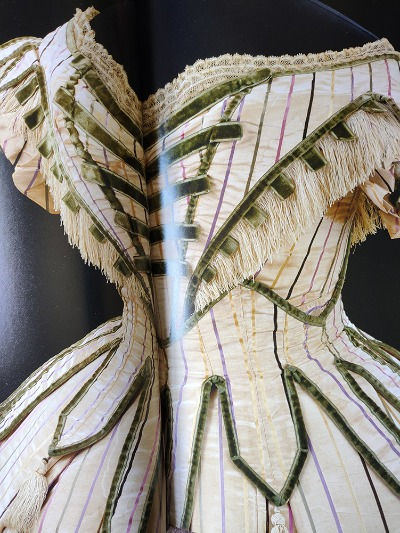
© V&A
The dresses are all late 1950's/1960's and the skirts are broad and round.
The crinoline
I had not made a wide hooped crinoline dress as of yet, at this point. Please remember that every part of every garment I construct has to be made of paper (or cardboard) and thread, only. I had constructed a wide pannier of the sort worn in the 18th century, from cardboard, and I would be making more of those. So now I wanted and needed to consider how to make the hoops that formed the large caged structures that were 19th century crinolines. And because this project was set to involve several pieces made to Pandora scale, I saw the chance to ease myself in.
"During the start of Queen Victoria's reign in 1837, the ideal shape of the Victorian woman was a long slim torso emphasised by wide hips...corsets were tightly laced and extended over the abdomen and down towards the hips. A chemise was commonly worn under the corset, and cut relatively low in order to prevent exposure. Over the corset, was the tight-fitting bodice featuring a low waistline. Along with the bodice was a long skirt, featuring layers of horsehair petticoats worn underneath to create fullness...In the 1840s, collapsed sleeves, low necklines, elongated V-shaped bodices, and fuller skirts characterised the dress styles of women...the middle of the decade saw sleeves flaring out from the elbow into a funnel shape...Skirts lengthened, while widths increased due to the introduction of the horsehair crinoline in 1847; becoming a status symbol of wealth...in 1856, skirts expanded even further; creating a dome shape, due to the invention of the first artificial cage crinoline...This was made possible by technology which allowed iron to be turned into steel, which could then be drawn into fine wires. Although often ridiculed by journalists and cartoonists of the time as the crinoline swelled in size, this innovation freed women from the heavy weight of petticoats and was a much more hygienic option".
When I came across this dress in the collection at The Met I could see moths wings again in the V-shape neckline, stretching it's wings from one side to the other across the top of the bodice.
And what of those panels on the front of the skirt!

© The Met
Ballgown, Maison Pingat (French), ca. 1864 silk, C.I.69.33.12a–c

© The Met 
© The Met 
© The Met
There isn't much to read about this dress on The Met website but I needed only these images to inspire me.
The visual links between those panels on the front and back of the skirt and this beautiful aged Giant moth specimen hanging framed on the wall of the office of Paradise Silk Mill, Macclesfield appeared striking.

This bleached, aged giant silk moth, likely dates itself to the Victorian era. It is faded and made bereft of it's original colouring but I thought I might want to reflect this beautiful final white/ivory/cream and brown colour combination, alongside the white purity of the working silk moth. That is, whilst also somehow hinting at the bright pinks and reds possible in the wings of these giants. There needed also to be the eye of a moths wing in the panels of my dress.

I like the lined segmentation and the ink in water quality of the colour of this wing in particular. It speaks to me not only of the shapes in the two hanging panels on the dress above but also of the sections I know I would making the skirt of my dress from.
Next I was delighted to come across an open wing shape across this bodice, similar to the Met gown but in fact from the ZTC collection of Zenzie Tinker, British textile conservator https://www.zenzietinker.co.uk/from-the-ztc-collection-early-victorian-bodice-jacket/
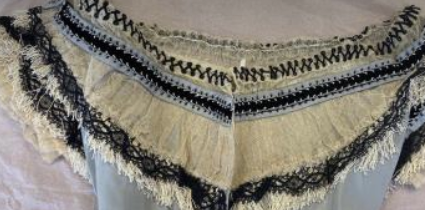
And I found the same neckline on dresses designed by Frederick Charles Worth
Some dresses from this period also had a train
And when designing fancy dress costumes Worth went wilder
For carnival wear Frederick Worth shows us directly how he was inspired directly by the shape of a butterfly/moth
Is it just me or can you see wings in the layers of these skirts. Laid down currently but ready to lift and take flight.
His sketches are beautiful I was particularly struck by the shawls in this first sketch, layers of wings upon layers of wings
Lace
Lace is something I have looked to mimic in paper. It features heavily in historic dress. Never before have I involved it directly and yet...The House of Embroidered Paper makes garments from paper and thread, and any technique that employs one or the other or both. Those are my self imposed rules.
There are so many cross overs of paper and fabric/thread. You can make paper by incorporating cloth and textiles by incorporating paper. Fashion accessories have been made from cardboard. For the bodice of the dress called Cloth of Gold I was planning to involve crochet, a pure thread technique, so now I asked myself why not also lace?
The Tonbridge Lace makers meet once a month and sometimes have guest speakers attend. I had been introduced to them through being asked to give a talk a few years previously so I decided to have a chat with Margaret Vick about the possibilities of our creating together a silk moth, from silk thread. A lace moth shape that I might incorporate into the design of this piece. In fact I would need more than one as I had in mind creating a mesh, perhaps as a shawl or to lay over the dress, with the moths trapped in it. But the first stage was to find a pattern and see if the group might be willing to help me. Margaret in fact would go on to create the two patterns involved herself. We needed to represent the shapes of both the Exotic giant silk moths whose wings point upwards and the Asian worker moths, whose wings point downwards. Other members of the group joined in to help her make 17 in total!
The Tuesday Lace Ladies’. - Margaret/Maggie Vick, Margaret Adams, Jenny Harrison, Kathy Clark, Anne Croucher
Photographs by Maggie Vick
For anyone who hasn't watched lace making, it begins with beautiful bobbins and a cushion



Work in progress photos by Margaret Vick
India
To link back to India I had a particular lady in mind, well in fact, at first, I had several ladies in mind, all of whom lived in the Grace & Favour apartments at Hampton Court in the 1850's:
- MARCHIONESS WELLESLEY: 30 November 1849; see Apt 2 Marianne (d 17 December 1853), an American Roman Catholic, daughter of Richard Caton, of Philadelphia, USA, and granddaughter of Charles Caroll Caton (d 1822) of Baltimore, who at his death was the last surviving signatory of the declaration of American Independence; widow of Robert Paterson. In 1825 she married Richard Colley, Marquess Wellesley (d 26 September 1842), KG, the famous Governor-General of India, 1797–1805, and the true consolidator of the British Empire in India. His younger brother was Arthur Wellesley, the Duke of Wellington. Marianne was a woman of wealth, beauty and refinement and her marriage to Wellesley greatly increased the happiness of the ‘remainder of his life’. She died at Hampton Court Palace
I liked the idea of making a dress for Marianne not just because of her husband's connection to India but also because she was an American who might therefore have seen giant silk moths as a child.
- LADY HILL: 3 August 1843 Anna Maria (1798–1886), born in Calcutta, fourth daughter of John Shore, 1st Lord Teignmouth, Gov-Gen India. In 1821 she married Col Sir Thomas Noel Hill (1784–1832), KCB. In 1801, Sir Thomas entered the army in the 10th Light Dragoons (afterwards 10th Hussars, who were stationed at the barracks at Hampton Court), after which he steadily rose in rank. They had six children. In 1881 Lady Hill was living with Annie Trevenen, her widowed daughter, Louise, her granddaughter, William, her grandson, Jane Austin and Jane Camps, lady’s maids; Elizabeth Newell, cook, Grace Ray, housemaid, and Henry Maskell, footman. Her apartment included the Wolsey Closet, which she used as a butler’s pantry. According to the Lady’s Pictorial in 1892, the room with ‘its fine frescoes and old oak panelling’ was hidden beneath a layer of whitewash. The article reports with some satisfaction that in 1890 the room was finally opened to the public and no longer ‘devoted to the washing of decanters and polishing of knives’
- LADY GORDON: In 1827 she married Lord Henry Gordon (1802–65), son of the 9th Marquess of Huntley. Her husband was a former major in the army who had business interests in the East India Company. In 1851 Lord and Lady Gordon were living in their apartment with their five daughters, two sons, a cook, a nurserymaid, a nursemaid, a housemaid and a footboy. By 1861 three of the older children had moved out, but an eighth child had arrived in 1853; a cook, two housemaids and a lady’s maid were also present. The Gordons were not popular with the authorities and were constantly being reprimanded for misconduct in the palace. In 1854, for example, Lady Gordon allowed water to pour through the floor of one of her rooms, which seeped behind pictures in the Queen’s Private Apartments; on 26 April 1858 Augustus Gordon (a palace resident, presumably her son) was to be prosecuted for defacing a notice cautioning the public against smoking; and in 1857 Lady Gordon was told off for lighting a fire near three elm trees in Home Park whilst having a picnic. The family’s fortunes took a severe turn for the worse in 1865 when Lord Gordon was declared bankrupt and the bailiffs seized almost all the family’s furniture. Lord Gordon disappeared but Lady Gordon and her family took refuge in Apt 6, at that time rarely used by Lady Hoste. The family never returned to Apt 4. By 1867 Louisa was reported to be ill; she died in May 1867 aged 52. Her daughters had Apt 20 and her sister-in-law, Apt 30.
Louisa had connections to the East India Company which was responsible for importing valuable textiles and the decoration thereof (for beetle wings?)
Or
- MRS HELEN BURGESS WATSON daughter of J Bettington. In 1845 she married Capt Rundle Burgess Watson (1809–60), who served with distinction in the First China War, commanding HMS Brilliant and being first to scale the walls of Chinkiang, where he was severely wounded. During the Crimean War he commanded a blockading squadron off Finland and was afterwards sent, during the Mutiny to India, where his health deteriorated. He was then appointed to Sheerness Dockyard, where he died (China and India re. silk moths)
Stitches in air
"Punto in aria (literally “stitch in air”) is an early form of needle lace devised in Italy. It is considered the first true lace because it was the first meant to be stitched alone, and not first onto a woven fabric"
The name of this piece came out of a conversation with Angie Wyman, Course Leader at the time of The Royal School of Needlework. I was telling her about paper having been referred to in French as the support of thoughts (hence the name of the mantua in the collection) and she told me that lace has been referred to as stitches in the air. What better name then for a piece about moths, that would incorporate lace. You can see an example here.
Design

For around the back of this dress I had designed a lace overskirt, to be made from individual Bombyx Mori moth lace shapes, made from fine silk thread but after seeing the Worth sketches above this overskirt became a shawl.
Making
These were some of the stages I went through in working out how to make the 'eyes' for the panels of the skirt.
I in fact then used the same thread technique to make an Indian/moth inspired necklace
And then there was the fringing. For this I used an inkle loom
Weaving Silk Stories is a new project in partnership with the independent charity Historic Royal Palaces, which is due to launch in 2027.
Paper sponsorship by Duni Global


