
1880's - research & making - Cocoons - silk dolmans and missing skirts
A detail from the history of silk in Britain silk
"Under Samuel’s leadership, the company became known as Samuel Courtauld & Co., and opened new mills in Halstead and Bocking, [Essex]. Samuel expanded into hand-loom and power-loom weaving as well as silk throwing, and from about 1830 began manufacturing the fabric that really made the family’s fortune [which would lead to The Courtauld Institute and thereby the Courtauld Art Gallery] - black silk mourning crape, which became the standard mourning dress in Victorian England.
The firm was always heavily dependent on young female workers; in 1838 over 92% of workforce was female. By 1850, the business had grown to employ over 2,000 people in three silk mills, and over 3,000 by the 1880s."
for source please click here
A Royal detail
Queen Victoria - was Queen of the United Kingdom of Great Britain and Ireland from 1837 until her death in 1901. Her reign was a period of industrial, political, scientific, and military change within the United Kingdom. In 1876, the British Parliament voted to grant her the additional title of Empress of India.
Fashion history
"The bustle was introduced as a distinct undergarment during the 1870s, supporting skirts which no longer sat over a crinoline, but which were gathered up at the back, projecting out below the waist. Also known as a 'dress-improver', or by its French name 'tournure', the bustle provided a foundation for this new arrangement of skirts via sculpted pleats and ruffles, often stiffened with horsehair. By the mid-1870s skirts narrowed further, and the puff of volume beneath the waist lowered. Volume became less pronounced but more expansive, as skirts developed trains fanning out behind the wearer. Tubular 'waterfall' bustles were used, providing extended support for the rear length of skirts which were now a focus of decoration, cascading down the back of the dress in an arrangement of ruffles, pleats or flounces".
As an example of cascading ruffles and pleats around the front there's this wedding dress:


© The Met Museum
wedding dress 1880 click here to see more images


Evening dress © Augusta Auctions
Second this elegant evening gown. What a stunning colour. And as a lovely combination of pattern and plain silk. A beautiful turquoise combined with a floral patterned gold on blue. Silhouette-wise, it’s firmly in the mid-1880s and has a train, suggestive of a more formal dress.
Whilst generally described using the word bustle some describe this type of dress by referencing the gathering up at the back that begun again in 1880's by again using the term polonaise, a design of dress from 100 years earlier. For more on this please see my post titled Looming. In an article on fashion from the 1880's:
"...Harper Franklin explains that “a significant trend was the polonaise style, featuring a long bodice and an overskirt tucked up to reveal the underskirt, which was frequently ruffled or pleated”. The revealing of the underskirt allowed women to also have their petticoats to be fashionable during this time.

© The Met 
© The Met 
© The Met
© The Met Museum
Similarly therefore to the dress above, this dress has draped fabric around the hips. A method of styling that comes up again and again in this decade. Presumably because, even if this is only an optical illusion it looks as if the fabric that is swathed across the front is then tied up and flowing down the back.
"The bustle silhouette, although primarily associated with the second half of the 19th century, originated in earlier fashions as a simple bump at the back of the dress, such as with late 17th-early 18th century mantuas and late 18th-early 19th century Empire dresses. The full-blown bustle silhouette had its first Victorian appearance in the late1860s, which started as fullness in skirts moving to the back of the dress. This fullness was drawn up in ties for walking that created a fashionable puff. This trendsetting puff expanded and was then built up with supports from a variety of different things such as horsehair, metal hoops and down. Styles of this period were often taken from historical inspiration and covered in various types of trim and lace. Accessories were petite and allowed for the focus on the large elaborate gowns. Around 1874, the style altered and the skirts began to hug the thighs in the front while the bustle at the back was reduced to a natural flow from the waist to the train. This period was marked by darker colors, asymmetrical drapery, oversize accessories and elongated forms created by full-length coats. Near the beginning of the 1880s the trends altered once again to include the bustle, this time it would reach its maximum potential with some skirts having the appearance of a full shelf at the back. The dense textiles preferred were covered in trimming, beadwork, puffs and bows to visually elevate them further. The feminine silhouette continued like this through 1889 before the skirts began to reduce and make way for the S-curve silhouette."
But how do you make a bustle? There were various methods, and various materials were used. Horse hair, as it says above, wire, steep hoops, baleen (whalebone), cane or heavy fabric. The image on the left shows two that could easily have been made of strips of cardboard as I have used previously. They look quite light, presumably made less so when draped with layers of fabric, but as someone who hates wearing belts I'd have struggled with something of this sort tied permanently around my waist.


Some were much longer:

Bustle American ca.1885 - Met Museum
And how did you keep warm outside. That is, what could you wear that would fit over a dress with a bustle? .
Dolmans were outdoor garments designed specifically to be worn over the fashionable bustles of the 1870s and 1880s. Constructed so that the back would sit comfortably over the most extreme bustle shape, they also complemented the gown beneath by being made of similarly luxurious fabrics and trimmings.
As one finds so often when looking at fashion history this item of women's fashion was adapted from an item of military wear meant for men.
"The dolman entered Western culture via Hungary starting in the sixteenth and continuing on into the nineteenth centuries where Hungarian hussars developed it into an item of formal military dress uniform. The jacket was cut tight and short, and decorated with passementerie throughout."
To read more about the development of dolmans as a fashion item please click here: https://fashion-era.com/fashion-history/victorian/mantle-clothing
To see a Royal dolman distinctly, almost the shape of a cape, worn by Queen Alexandra in the 1870s and held today in the Royal Ceremonial dress collection please click here
But to see one less cape shaped, more jacket I started in '19th-Century Fashion in Detail' by Lucy Johnston, a Thames & Hudson and V&A publication, where it says:
"The front, back and sleeves of this dolman are trimmed with exotic marabou feathers made into wide bands interspersed with small, flat feathers...dyed to a lighter tone giving definition and depth to the appearance of it...heavy wooden braid-covered pendant tassels are used to trim the pointed panels of the garment...and help keep the hang of the panels...straight when the dolman was being worn."
Online you can see it here: https://collections.vam.ac.uk/item/O122396/mantle-redmayne-and-co/#:~:text=Womenswear,in%20the%201860s%20to%201880s.
Pretty quickly from there I moved on to looking at examples made by the man who must surely be considered the master of the art of designing dolmans. Click here for a link to MFA Boston which holds in its collection a brown dolman made by Emile Pingat
"Emile Pingat (French, 1820-1901). Woman's dolman, ca. 1883-90. Silk; velvet embroidered with silk, silk lace, chenille fringe, feathers, silk braid; 60 cm (23 5/8 in). Boston: Museum of Fine Arts, 1972.911. Gift of Mrs. Norman J. Padelford"
-
And when I realised this white dolman with fur trim was by him also I knew I had found my primary inspiration: https://collections.vam.ac.uk/item/O128007/jacket-emile-pingat/
This fur-trimmed mantle was made in the fashion house of the Parisian designer Emile Pingat (1885):
"Constructed as a dolman, it resembles a half-jacket, half-cape with its loose, sling-like sleeves cut with the body of the garment. It has a single hook fastening at the neck and is designed to fall straight down in a smooth line at the front, and to sit neatly over the fashionably exaggerated bustle at the back. The silk voided velvet is woven with a textured design of ostrich feathers and the silk chenille trimming is reminiscent of marabou. The neck and fronts, cuffs and hems are edged with bands of white arctic fox...that would have been trapped in the wild, probably in Northern Canada, and imported through London. Lined with machine -quilted satin, this dolman would have been warm to wear."
- 19th-Century Fashion in Detail by Lucy Johnston, a Thames & Hudson and V&A publication
The Met Museum has many Emile Pingat dolmans in their collection:


"By the 1880s, Pingat was known for his outerwear, including day and evening cloaks, jackets, and dolmans. While cloaks and jackets are still worn today, the dolman was an outer garment designed to accommodate the large bustle of the 1880s, and the term is used for any outer garment designed with the bustle in mind."


Other styles of outer wear were of course designed and able to fit over bustles. Certain capes did so simply by hanging far above them. Here are some House of Pingat examples:


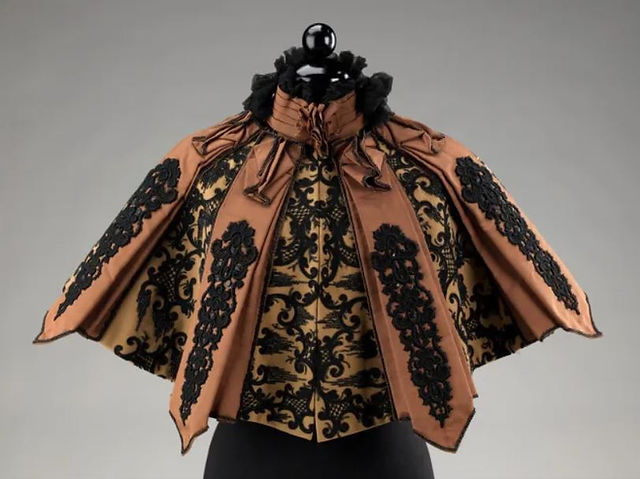
please click on each image to be taken to it's source
Others, such as this red and black beaded example: https://asufidmmuseum.asu.edu/learn/articles/emile-pingat kept their length in the front.
It's the level of decoration that Maison Pingat was capable of that is really quite outstanding. All of these examples are so spectacular it's hard to imagine that the women who wore them weren't in costume on the stage or in a movie, but were simply living their (grand) lives.
Designers (and women) of the 1800's weren't of course so far removed as we are from the late 17th century when frock coats like this were being produced for men! Pingat's dedication to decoration and beauty would therefore likely have seemed less noteworthy but the hours of work that went into the hand embroidery on the dolmans and cloaks in this post is really quite remarkable.

This beige mantle looks like a dolman from the front but turn it around and you see that it was in fact designed to go over a straighter skirt:.https://collections.lacma.org/node/213826
Visiting
I then made a trip (not my first, I'm a fan) to the wonderful costume research centre at Worthing Museum where head curator Gerry Connolly had put out three Dolmans for me to see.


Note: You can hear an interview I gave to Lucy Clayton for
her Dress Fancy podcast, which was recorded in the Worthing
Museum Costume research centre by clicking here
Whilst the three shown here are all from the 1800's they are also all quite different. The first surprised me simply by being floor length. I'd seen only short dolmans up until this point (remember it's the fact that the jacket was designed to sit over a bustle that is the key to defining it as a dolman).
With a pattern on the fabric that struck me as in fact a bit manly but with glittering beaded decoration, soft bobbles of a sort I remember making at school and a heavy fringe, this piece seemed to proffer an unusual combination of textures and of colours. Whilst cataloguing it they had briefly wondered whether it had been made in fact from a shawl.


The brown dolman below likewise seemed surprising, for it's design of rippling ovals, which might have been much more modern in it's origins. Surely this is a pattern from the 1960's or, given the dark, rich brown velvet, from the 1970's? But no, here again you can see the lift at the back for a bustle to sit beneath. Again the decoration on the back, bottom edge (surely it's tail!) is beaded and dazzling, arguably a better match to the sheen of the silk velvet. Short instead of long, the construction of this was different also from the first piece, with an open gap in the bottom curve of the sleeve where the fabric is bent round, rather than there being a line of stitching attaching the two parts, sleeve and body.


And finally, I saw a lightweight short silk dolman, though in a heavy colour. The ancestor perhaps of the many modern short lingerie robes or dressing gowns made today from man made satin effect fabrics. The fabric of this piece is silk of course. But it's that bustle bump, isn't it, that stands out..


Do also have a look at this pretty lightweight white dolman: https://curiouslychanging.tumblr.com/post/31023925763
On this trip I was looking at Dolman construction but also for any silk polonaise robes or examples of Spitalfields silk that they might have in the Worthing Museum collection. Please click here to see what I saw.
I was very grateful to be able, at Worthing Museum, to ask to see dolmans in silk as part of my research for Weaving Silk Stories, the collection. I'd like to conclude my documented research into dolmans here by including an image of a dolman by another master in this area (and all of fashion), Charles Frederick Worth. The piece in velvet is of course but in that era velvet was silk velvet. For more images of the piece do have a look on the website of The Met Museum for this spectacular dolman here

Many other dolmans I've been looking at in books and online incorporate other textile types (for example, wool) alongside silk. That's less of a distraction (in terms of my research for Weaving Silk Stories) than I initially thought because my research has revealed that the silk mills I'm working with have incorporated other types of thread with their use of silk (to read about how this applies to Whitchuch Silk Mill please click here). So in the making of my pieces I concluded I could allow myself a little leeway. That said, the only material type other than silk thread and paper I have needed to use has been some of the man-made embroidery thread I always used previously. The decorative effects of the passementerie employed on the wonderful dolmans above would prove very inspiring. So how did I apply this research?
Wearing a bustle went on into the1880's. For a striking painting demonstrating the silhouette well by showing a lady in black please click here
You can see how I went on to make my own silk white dolman below, but first I need to include images of part of a wedding dress from Macclesfield Silk Museum to describe why I started off believing I would only be making the top part of this outfit and later decided to add in the missing dress beneath. This dress is maroon/purple and yet it was worn by a bride. As you can read here wearing white to get married in as standard is a relatively new tradition. Arguably it was set by Queen Victoria (after a run of silver Royal wedding dresses in previous decades). She married in 1840 however by the 1880's white wedding dresses might have been popular amongst those who could afford a new dress to marry in and one made of silk. Here are a few more examples:


No doubt this tradition was fuelled by the use of (white) parachute silk being co-opted and refashioned into wedding dresses during WWII as I considered in this piece here But previous to that ordinary women often simply wore their best dress to marry in (which might be any colour).
This dress was owned in the 1880's and worn by Evelyn Burn when she married in Calcutta Cathedral. It is a dress that fits over a bustle so had to be constructed with internal ties (to pull up parts of it's length). It would have sat over a separate skirt worn beneath. It's accompanying skirt hasn't survived. I like the idea of part of an outfit being lost, It ties into a project I did looking at lost clothes which you can view in photo form here. A dolman displayed on it's own as I had at first planned would look bare at the bottom and reflect the idea of a missing skirt but I now wanted to make it.

From the back
Like dolmans, dresses with bustles were at their most popular in the 1880's (a little into the 1890's) but arguably not every woman could afford to simply abandon their best dress.


Note: there is a beautiful bit of silk passementarie in the form of a tassel fringe, on the pocket.
I'd been looking to illustrations of dresses from the same period here:
and found this is a beautiful example of a matching dress and dolman
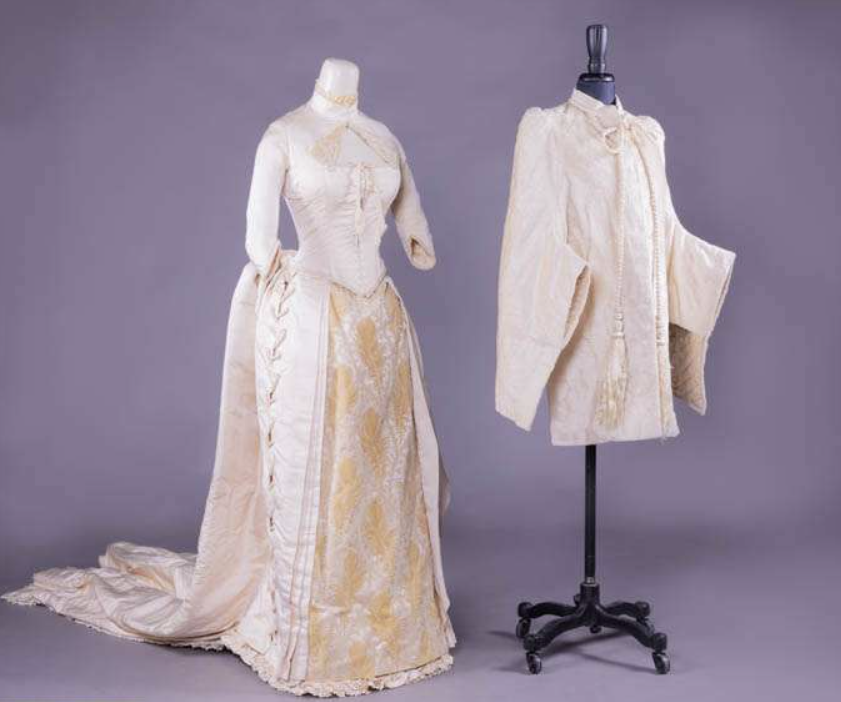
I was planning to use quilting, an oft employed technique used for warmer wear in the 1800's. But I was also intrigued by the buttons on the Macclesfield Silk Museum dress; their roundness:
1780/'81©Glasgow Museum 
Macclesfield Museum
Finally looking at this cloak from the 1880's, the bobble cloak as I call it, made me think of silk cocoons and gave me an idea https://collections.vam.ac.uk/item/O114452/cape-vinogradova/?carousel-image=2019LM3460
Design

Making (the top half):
I began in white, reflecting: what we think of today as the traditional colour of a wedding dress; the colour of a working silk worm; the silk worm cocoon; raw silk: And I began with weaving; making a simple loom and using paper plus silk thread.


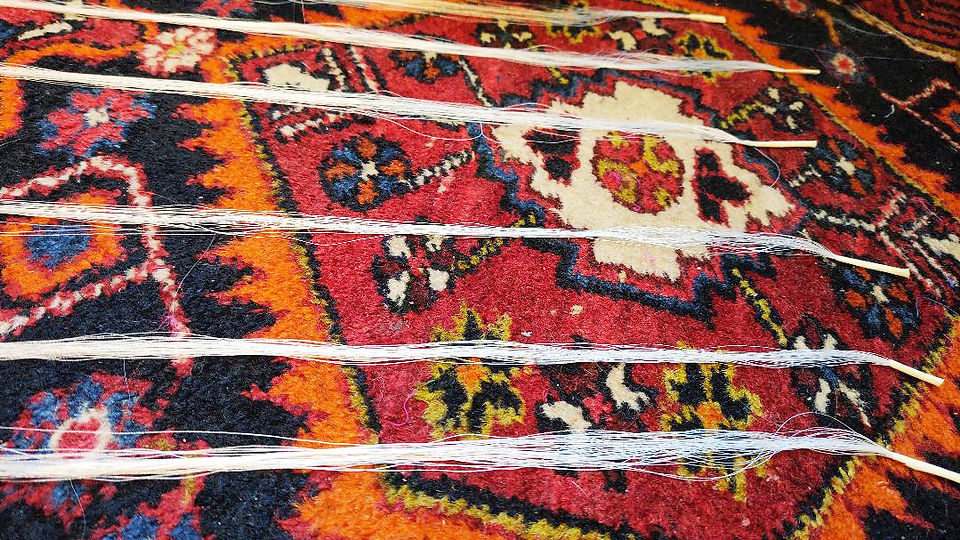


This I used in various places as part of the fabric of the dolman
Gathering strands of the raw silk I had from Whitchurch Silk Mill I was able to reproduce a fur edged collar effect.
And House of Embroidered Paper volunteer Margaret made some more woven paper which I would use for part of the skirt and leaves on the piece called Cloth of Gold
And at the monthly meeting of The House of Embroidered Paper volunteers we made silk paper from raw unspun silk and then I made the dolmans uniquely shaped sleeves
Because this was one of the planned Pandora doll sized pieces in the Weaving Silk Stories collection any buttons must be tiny
Weaving Silk Stories is a new project in partnership with the independent charity Historic Royal Palaces, which is due to launch in 2027.
Paper sponsorship by Duni Global


